
Rare disease market research Saudi Arabia is the work of finding a diagnosed group of patients, not of stretching a national percentage. This page sits on healthcare market research, beside the ranking of rare-disease research firms and the hematology briefing for Saudi Arabia. An orphan drug is a medicine developed for a rare condition. A carrier study counts people who can pass a gene on. A tender list counts packs a buyer might order. Those are three files.
What the regulator has published
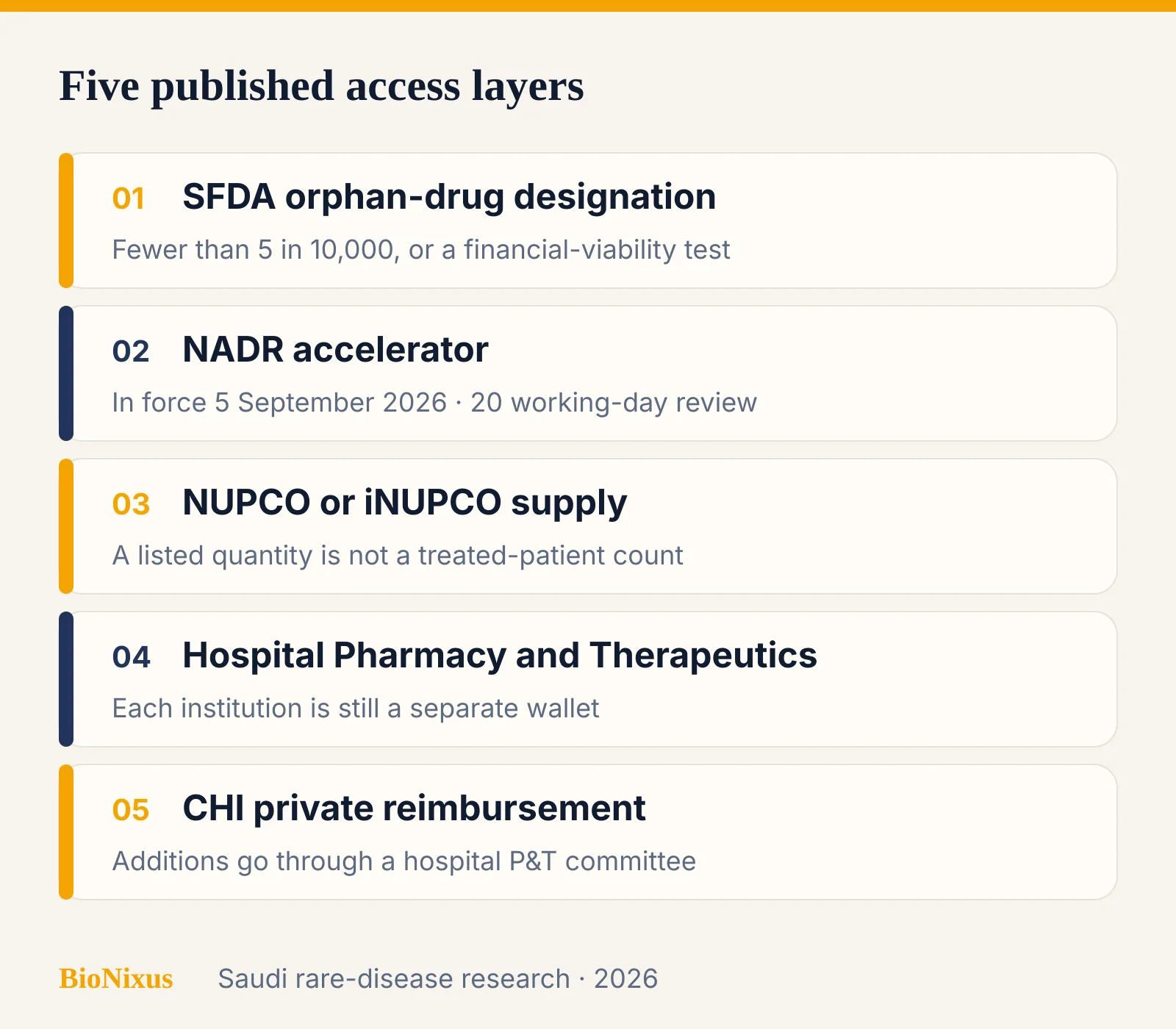
The Saudi Food and Drug Authority, the SFDA, published a regulatory framework called the New Accelerator Program for Drugs for Rare Diseases, NADR, version 1.0. It was issued on 5 August 2026 and came into force on 5 September 2026 (SFDA NADR framework). The accelerator is a pathway for rare-disease drugs. It is not a census of patients.
The Authority also publishes Guidance for Orphan Drug Designation, document DS-G-101-V1.1 (SFDA orphan-drug designation guidance). Orphan-drug designation is the status a company asks for when it wants a rare-disease medicine treated under that guidance. Designation is not a hospital order, and it is not proof that a patient has been found.
Named products already have public drug-information pages. The vutrisiran page, for the brand Amvuttra, was last updated on 30 September 2026 (SFDA, vutrisiran). Spinraza, the brand for nusinersen, is listed as a 12 mg solution for injection (SFDA, Spinraza). Zolgensma, the brand for onasemnogene abeparvovec, is on the same drug-information system (SFDA, Zolgensma). A page on that system tells you the product is described there. It does not tell you how many people received it last quarter.
A tender quantity is not a patient
NUPCO, the National Unified Procurement Company, runs an open framework for immunology and rare-disease medicines, tender NPT0045/25 (NUPCO NPT0045/25). The item list publishes tender quantities. The list itself says those quantities are not awards and not treated-patient counts (NPT0045/25 item list). Read the quantity as a planning number. Then ask the hospital what was dispensed.
A BidDetail notice dated 23 August 2026 summarises an iNUPCO marketplace listing for insured pharmaceutical items (BidDetail, 23 August 2026). iNUPCO is the electronic marketplace. The notice is not an SFDA label and not a published award. Do not quote it as either.
The Council of Health Insurance publishes the CHI Drug Formulary, called Dhaman (CHI Dhaman formulary). That is the private-insurance list. It is not the NUPCO framework. A 2024 country note on the Saudi health system and medicine prices is a third file again (PPRI 2024). Use it for the pricing context. Do not use it as a rare-disease headcount. The General Authority for Statistics publishes 2024 population estimates (GASTAT, 2024). Residents are the backdrop. They are not the diagnosed cohort.
Papers that describe the system
Several papers discuss policy. Cite them for the question they actually studied.
- Abozaid and colleagues reported policy insights from a multi-stakeholder workshop on a rare-disease and orphan-drug ecosystem (Frontiers in Pharmacology, 2025). A workshop is not a patient registry.
- Abu Esba and colleagues used a Delphi exercise on the challenges of evaluating and reimbursing rare-disease drugs (Journal of Pharmaceutical Policy and Practice, 2025). A Delphi records expert agreement. It does not count patients.
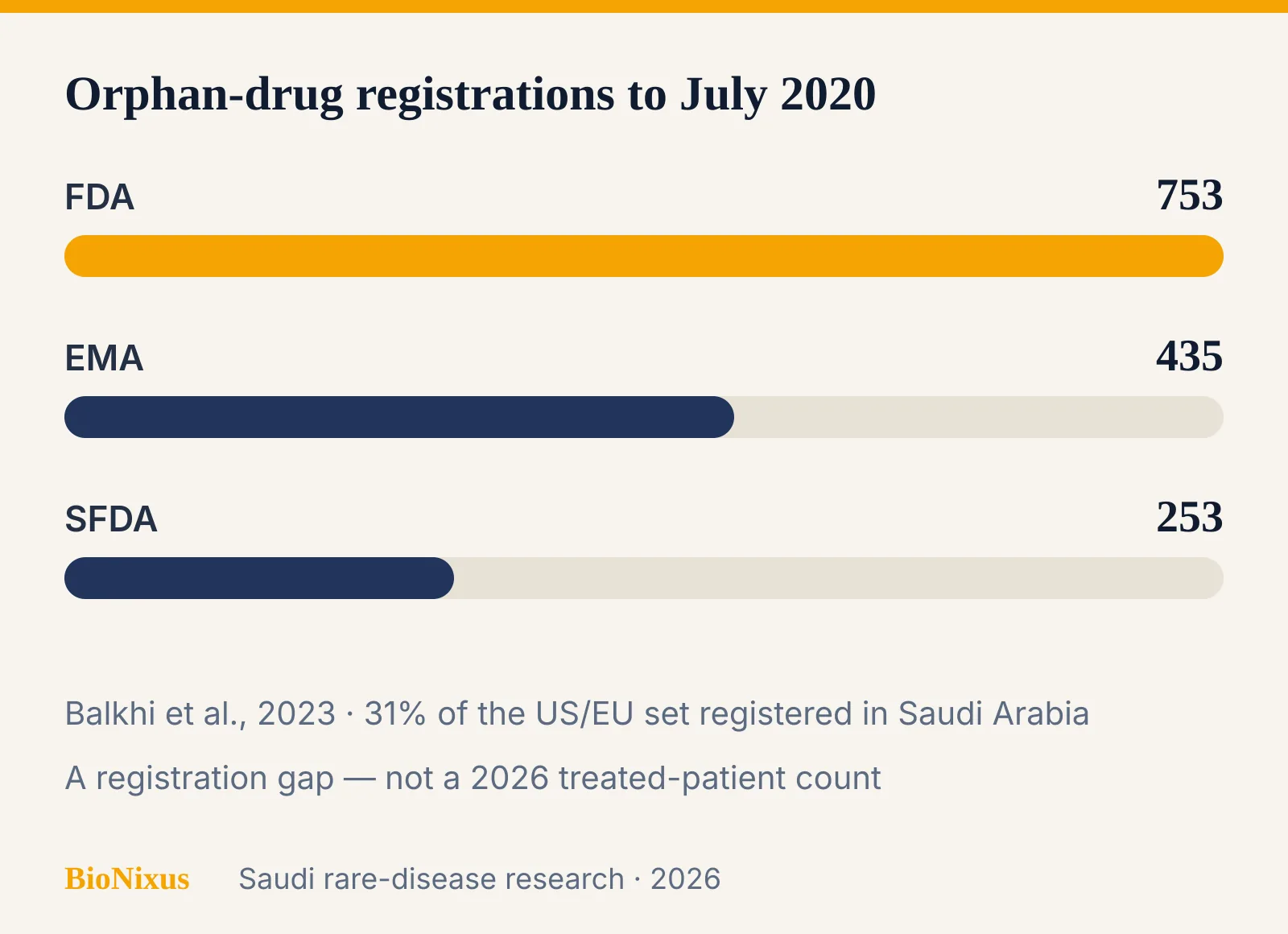
- Balkhi and colleagues compared orphan-drug policies in Saudi Arabia, the United States and the European Union (Saudi Pharmaceutical Journal, 2023). A policy comparison is not a 2026 treated-patient count.
- A separate Abozaid review, in BMJ Open in 2025, gathered how different countries define a rare disease and an orphan drug (BMJ Open, 2025). Definitions differ. Do not import one country’s cutoff and call it the SFDA rule unless the SFDA guidance says so.
- Al-Jedai and colleagues describe a step toward a national multi-criteria framework for health decisions (Value in Health Regional Issues, 2024). The paper’s title calls it a step toward that framework. It is not, by itself, the form a NUPCO buyer fills in.
Grand View Research, IMARC and Fortune Business Insights sell rare-disease and orphan-drug outlooks. Those pages are syndicated sizing. They are not a diagnosed cohort. A company that takes only that slide to a hospital committee will be asked where the patients are.
Papers that describe families and genes
Cousin marriage, called consanguinity when the spouses are relatives, is studied because some rare conditions are more common when parents share ancestry. It is still not a forecast for one drug.
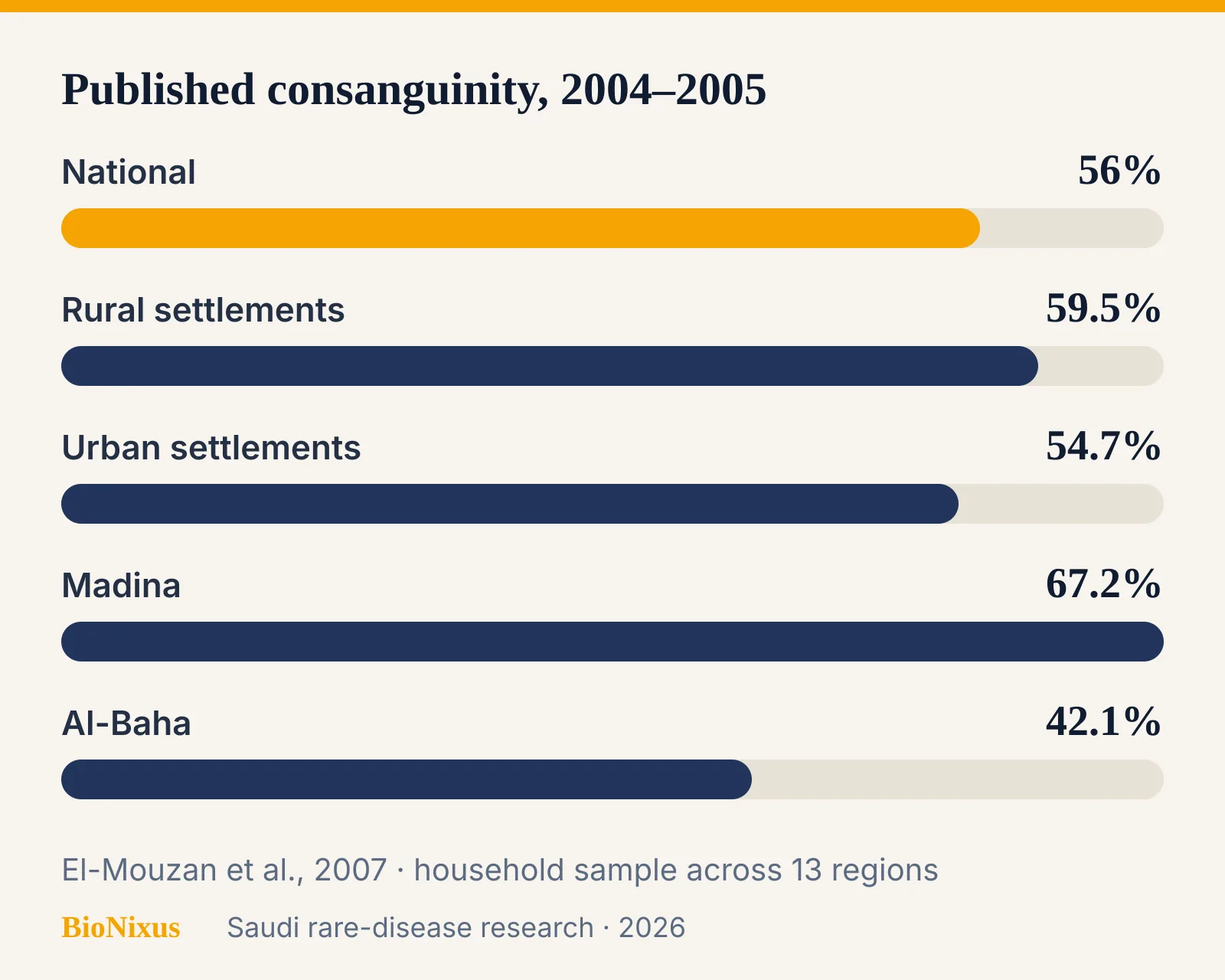
- El-Mouzan and colleagues measured how consanguinity varies by region (Saudi Medical Journal, 2007). A national pattern can hide the city where a clinic actually sits.
- El-Hazmi and colleagues also studied consanguinity in the Saudi population (Journal of Medical Genetics, 1995). That is an earlier paper. Do not average it with the later one into a single rate this page does not calculate.
- Monies and colleagues described genetic diseases found in the first 1,000 diagnostic panels and exomes (Human Genetics, 2017). An exome test reads the coding parts of a person’s genes. One thousand tests are a laboratory series. They are not the national population.
- A Ministry of Health paper by Alhashem and colleagues discusses genetic data sharing and artificial intelligence from a cross-section of the Saudi human genome (Ministry of Health). Data sharing is not a treatment count.
- Abouelhoda and colleagues write about Arab founder variants, gene changes that trace back to a shared ancestor, and what they mean for clinical genomics (Med, 2025). A founder variant can explain why a condition clusters. It does not name the hospital that will infuse a drug.
Screening and single-disease papers have the same limit. Alfadhel and colleagues reported the incidence of disorders found by the expanded newborn screening programme (Journal of Paediatrics and Child Health, 2017). A later paper from the same lead author is a thirteen-year review of inborn errors of metabolism at one tertiary centre (Orphanet Journal of Rare Diseases, 2016). An inborn error of metabolism is an inherited problem in how the body handles food components. A centre series is not every hospital in the Kingdom.
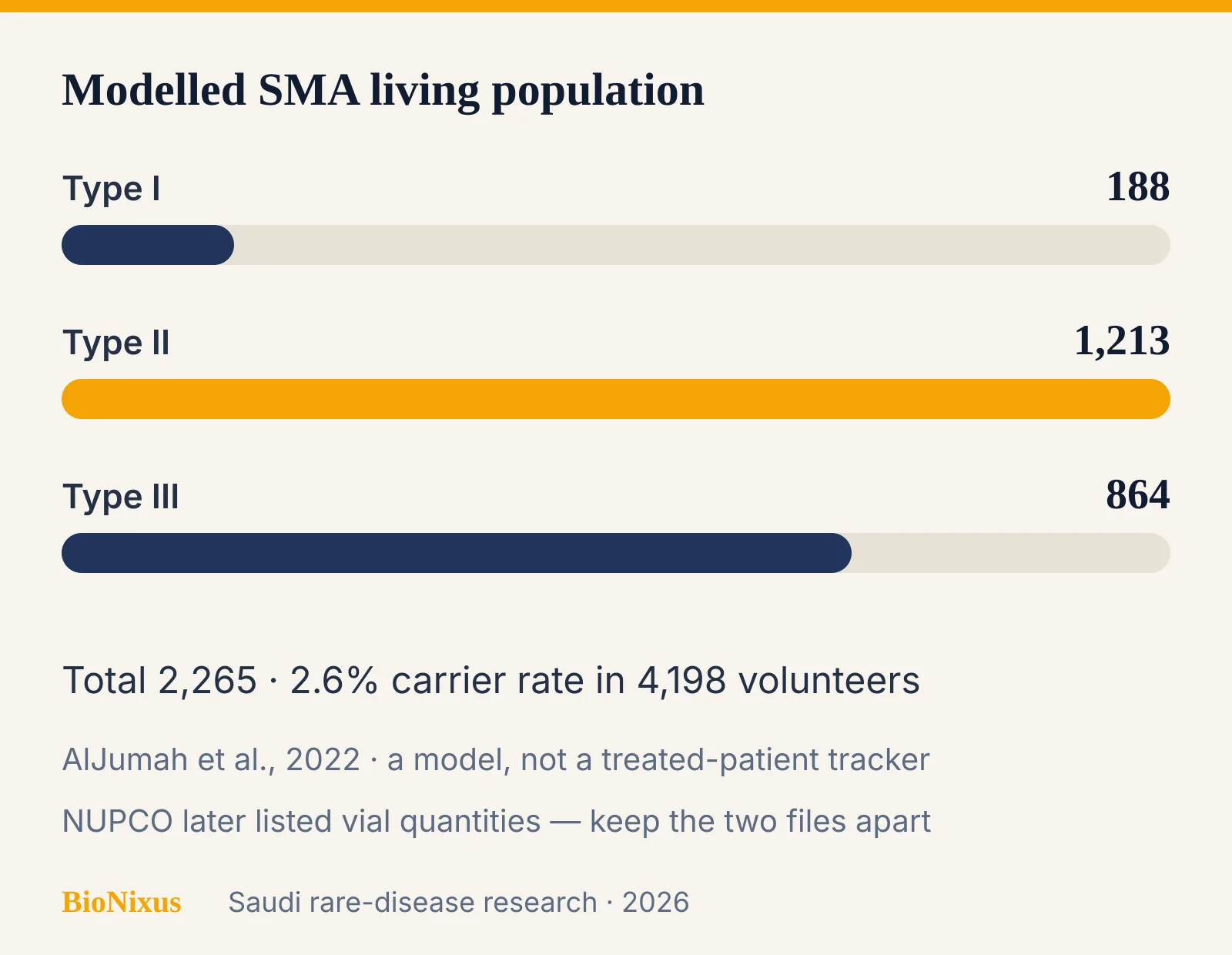
Spinal muscular atrophy, SMA, is a genetic condition that weakens muscles. Al Jumah and colleagues studied how often people in Saudi Arabia carry an SMA gene (Molecular Genetics and Genomic Medicine, 2022). Alharbi and colleagues discuss SMA genetic epidemiology and the case for premarital genomic screening in Arab populations (Communications Medicine, 2024). Al-Muhaizea and colleagues published a 2020 update on how SMA is managed in Saudi Arabia (Frontiers in Pediatrics, 2021). Management advice is not a count of people on Spinraza or Zolgensma. A carrier frequency is not the number of people living with the disease, unless the paper you are quoting is explicitly a prevalence model and you cite that model’s own limits.
Cystic fibrosis is another inherited disease, tied to changes in a gene called CFTR. Banjar and colleagues mapped where those gene changes are found in Saudi Arabia (International Journal of Pediatrics and Adolescent Medicine, 2021). A map of mutations is not a map of treated patients. Do not replace it with a genotype mix from Europe or the United States.
What not to do with those papers
Do not multiply a carrier rate by the population estimates and call the result demand. The carrier papers and the population publication answer different questions. Do not treat a NUPCO quantity as the number of people treated. The list says it is not that. Do not treat a marketplace notice as an award. Do not treat a workshop or a Delphi as a registry. Do not treat orphan-drug designation as a chair that is already filled.
If two papers describe the same topic years apart, quote both with their years. Do not blend them into a newer number they did not publish.
Questions to put in the brief
Write the decision first. It might be a NADR file, a place on the NPT0045/25 list, a Dhaman question, or the first centre that will actually see the patient.
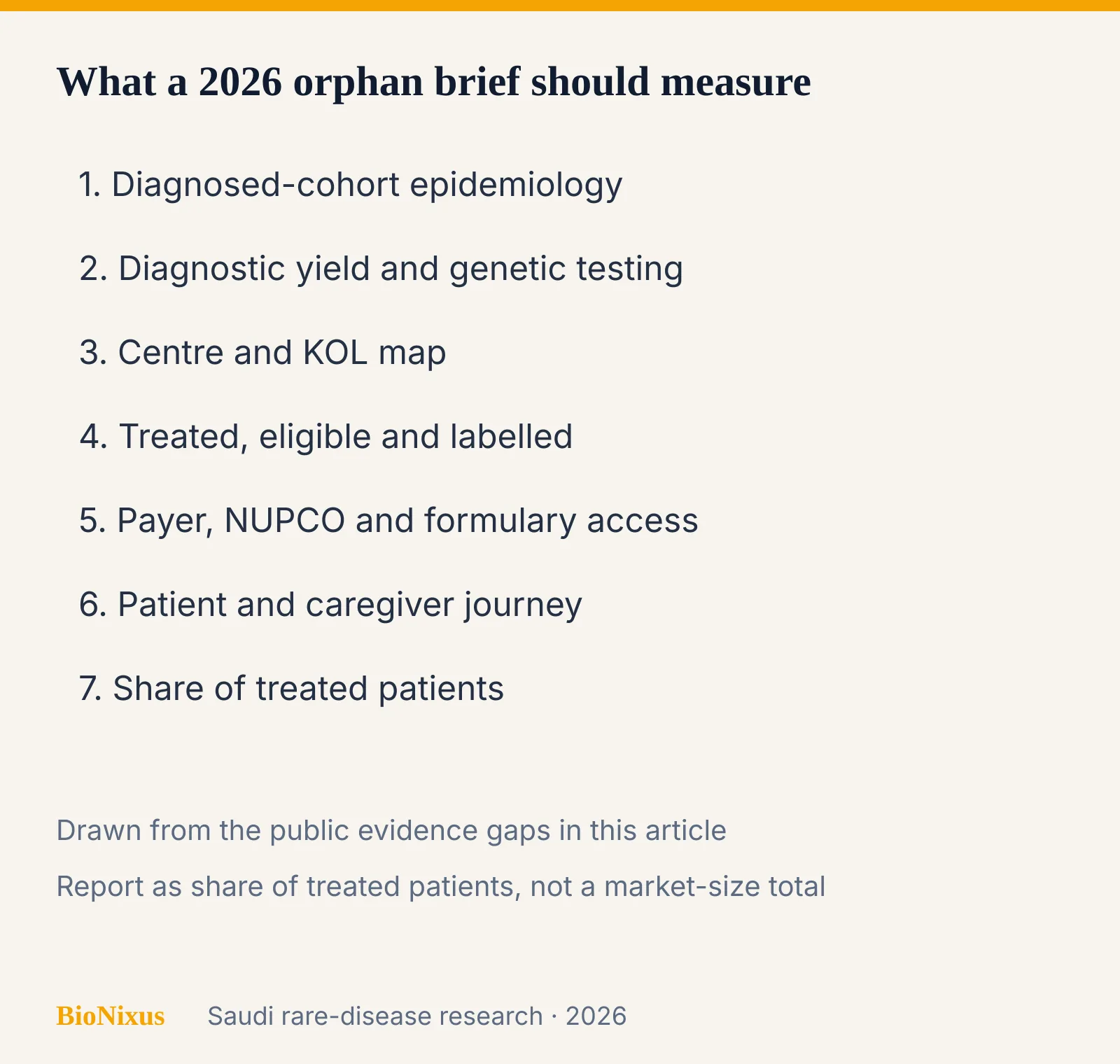
- Which definition. Say whether the brief uses the SFDA designation guidance or a definition from the BMJ Open review. They are not interchangeable by default.
- Which cohort. Name the test that confirms the diagnosis, and the hospitals that run it. The first 1,000 exomes are not that list unless those hospitals are in the sample.
- Which product page. If the drug is vutrisiran, Spinraza or Zolgensma, cite the drug-information page for what it is. Then measure use separately.
- Which supply route. Keep the NPT0045/25 framework, the August 2026 marketplace notice and a hospital purchase apart.
- Which family fact. If cousin marriage matters for this disease, say which paper and which region. Do not use one national sentence for every city.
- Which payer. Dhaman is the private list. NUPCO is the government framework. Ask which wallet funds the named centre.
Report the result as a share of diagnosed patients who are treated, at named centres. Ask for Arabic and English instruments. Ask the agency which paper it will not convert into a national total.
How to brief BioNixus
BioNixus is a primary market research firm for pharmaceutical, medical device and healthcare companies. It was founded in 2012. Custom studies are usually priced at $10k–$60k. The firm has 40 client reviews on its public profiles. The line “Guaranteed in writing” covers the agreed scope and timeline. It does not cover what the interviews will find.
Leadership offices are in Sheridan, Wyoming, London, and Sheikh Zayed, Giza. Field offices are in Dubai, Al Khobar, and Salmiya, Kuwait. São Paulo is a field office for LATAM.
To brief a rare-disease study, use the contact form or email admin@bionixus.com. Say which diagnosis, which hospital and which decision the study has to answer.
References
- Saudi Food and Drug Authority. Regulatory Framework for Rare Diseases Drugs: The New Accelerator Program for Drugs for Rare Diseases (NADR), Version 1.0. Issued 5 August 2026; in force 5 September 2026. Source (accessed 16 October 2026).
- Saudi Food and Drug Authority. Guidance for Orphan Drug Designation, DS-G-101-V1.1. Source (accessed 16 October 2026).
- Saudi Food and Drug Authority. Drug approvals page for vutrisiran (Amvuttra). Page last updated 30 September 2026. Source (accessed 16 October 2026).
- Saudi Food and Drug Authority, Saudi Drug Information System. Spinraza (nusinersen) 12 mg solution for injection. Source (accessed 16 October 2026).
- Saudi Food and Drug Authority, Saudi Drug Information System. Zolgensma (onasemnogene abeparvovec). Source (accessed 16 October 2026).
- National Unified Procurement Company (NUPCO). NPT0045/25 Immunology and Rare Diseases item list (updated). Tender quantities, not awards or treated-patient counts. Source (accessed 16 October 2026).
- NUPCO. Open framework agreement for immunology and rare-disease medicines, tender NPT0045/25. Source (accessed 16 October 2026).
- BidDetail tender notice, 23 August 2026. Summarises an iNUPCO-insured pharmaceutical-items marketplace listing. Marketplace notice, not an SFDA label and not a published award. Source (accessed 16 October 2026).
- Abozaid GM, Al-Omar HA, Alrabiah A, AlMuaither A, McKnight AJ. Towards a sustainable rare disease and orphan drug ecosystem in Saudi Arabia: policy insights from a multi-stakeholder workshop. Front Pharmacol. 2025;16:1583477. Source (accessed 16 October 2026).
- Abu Esba LC, Yousef CC, Khan MA, et al. Challenges in evaluation and reimbursement of drugs for rare diseases in Saudi Arabia: a Delphi expert consensus. J Pharm Policy Pract. 2025. Source (accessed 16 October 2026).
- Balkhi B, Almuaither A, Alqahtani S. Cross-national comparative study of orphan drug policies in Saudi Arabia, the United States, and the European Union. Saudi Pharm J. 2023;31(9):101738. Source (accessed 16 October 2026).
- Abozaid GM, Kerr K, Alomary H, Al-Omar HA, McKnight A. Global insight into rare disease and orphan drug definitions: a systematic literature review. BMJ Open. 2025;15(1):e086527. doi:10.1136/bmjopen-2024-086527. Source (accessed 16 October 2026).
- Al-Jedai A, et al. A step toward the development of the first national multi-criteria decision analysis framework to support healthcare decision making in Saudi Arabia. Value Health Reg Issues. 2024. Source (accessed 16 October 2026).
- El-Mouzan MI, Al-Salloum AA, Al-Herbish AS, Qurachi MM, Al-Omar AA. Regional variations in the prevalence of consanguinity in Saudi Arabia. Saudi Med J. 2007;28(12):1881–1884. Source (accessed 16 October 2026).
- El-Hazmi MA, Al-Swailem AR, Warsy AS, Al-Swailem AM, Sulaimani R, Al-Meshari AA. Consanguinity among the Saudi Arabian population. J Med Genet. 1995;32(8):623–626. Source (accessed 16 October 2026).
- Monies D, Abouelhoda M, AlSayed M, et al. The landscape of genetic diseases in Saudi Arabia based on the first 1000 diagnostic panels and exomes. Hum Genet. 2017;136(8):921–939. Source (accessed 16 October 2026).
- Alhashem A, et al. Genetic data sharing and artificial intelligence in the era of personalized medicine based on a cross-sectional analysis of the Saudi human genome. Ministry of Health Knowledge Management. Source (accessed 16 October 2026).
- Alfadhel M, Al Othaim A, Al Saif S, et al. Expanded Newborn Screening Program in Saudi Arabia: incidence of screened disorders. J Paediatr Child Health. 2017. Source (accessed 16 October 2026).
- Alfadhel M, Benmeakel M, Hossain MA, et al. Thirteen year retrospective review of the spectrum of inborn errors of metabolism presenting in a tertiary center in Saudi Arabia. Orphanet J Rare Dis. 2016;11:196. Source (accessed 16 October 2026).
- Al Jumah M, Al Rajeh S, Eyaid W, et al. Spinal muscular atrophy carrier frequency in Saudi Arabia. Mol Genet Genomic Med. 2022. Source (accessed 16 October 2026).
- Alharbi SN, et al. Spinal muscular atrophy genetic epidemiology and the case for premarital genomic screening in Arab populations. Commun Med. 2024;4. Source (accessed 16 October 2026).
- Al-Muhaizea M, et al. 2020 update to spinal muscular atrophy management in Saudi Arabia. Front Pediatr. 2021;9:684134. Source (accessed 16 October 2026).
- Banjar H, Al-Mogarri I, Nizami I, et al. Geographic distribution of cystic fibrosis transmembrane conductance regulator (CFTR) gene mutations in Saudi Arabia. Int J Pediatr Adolesc Med. 2021. Source (accessed 16 October 2026).
- General Authority for Statistics (GASTAT). Population Estimates Statistics 2024 (English). Source (accessed 16 October 2026).
- PPRI / Austrian National Public Health Institute. Healthcare system and pharmaceutical pricing in Saudi Arabia (2024). Source (accessed 16 October 2026).
- Council of Health Insurance. CHI Drug Formulary (Dhaman). Source (accessed 16 October 2026).
- Abouelhoda M, et al. Arab founder variants: contributions to clinical genomics and precision medicine. Med. 2025. Source (accessed 16 October 2026).
- Grand View Research. Saudi Arabia / Middle East rare-disease and orphan-drug outlook pages. Syndicated market-size estimates; not a diagnosed-cohort or treated-patient study. (accessed 16 October 2026).
- IMARC Group. Saudi Arabia rare-disease / orphan-drug market report pages. (accessed 16 October 2026).
- Fortune Business Insights. Rare-disease treatment market report pages that often occupy adjacent queries. (accessed 16 October 2026).