Thiqa obesity reimbursement is a payer question in Abu Dhabi, not a national obesity percentage. This page sits beside the UAE obesity market and the healthcare market research hub. GLP-1 medicines act on a gut-hormone pathway and are used for weight and for diabetes. Abu Dhabi GLP-1 coverage under Thiqa depends on a written policy. Obesity market research UAE that skips that policy will count the wrong people.
What Thiqa is
Thiqa is Abu Dhabi government cover for UAE nationals and people of similar status. Daman has managed the programme since 2008 (Thiqa). For Abu Dhabi nationals, the eligibility page describes a full public and private Thiqa network, emergency cover in the UAE and worldwide, and no annual benefit limit (Thiqa eligibility). No annual limit is what that page says about the programme. It is not a statement that every obesity medicine is paid, and it is not a count of members.
The Department of Health also has a policy on managed-entry and risk-sharing agreements. It applies to Thiqa members, to basic-plan members, and to the group the department labels ABM (Department of Health, managed entry). A managed-entry deal is a way to pay while more evidence is collected. It is a different document from the obesity-medicine policy. The department’s standards index is the shelf those documents sit on (Department of Health standards). A standard for centres of excellence in bariatric surgery, dated September 2022, is about surgical centres (bariatric surgery standard, September 2022). Surgery is not the non-surgical obesity standard. Do not use one to answer the other.
The policy and the standard
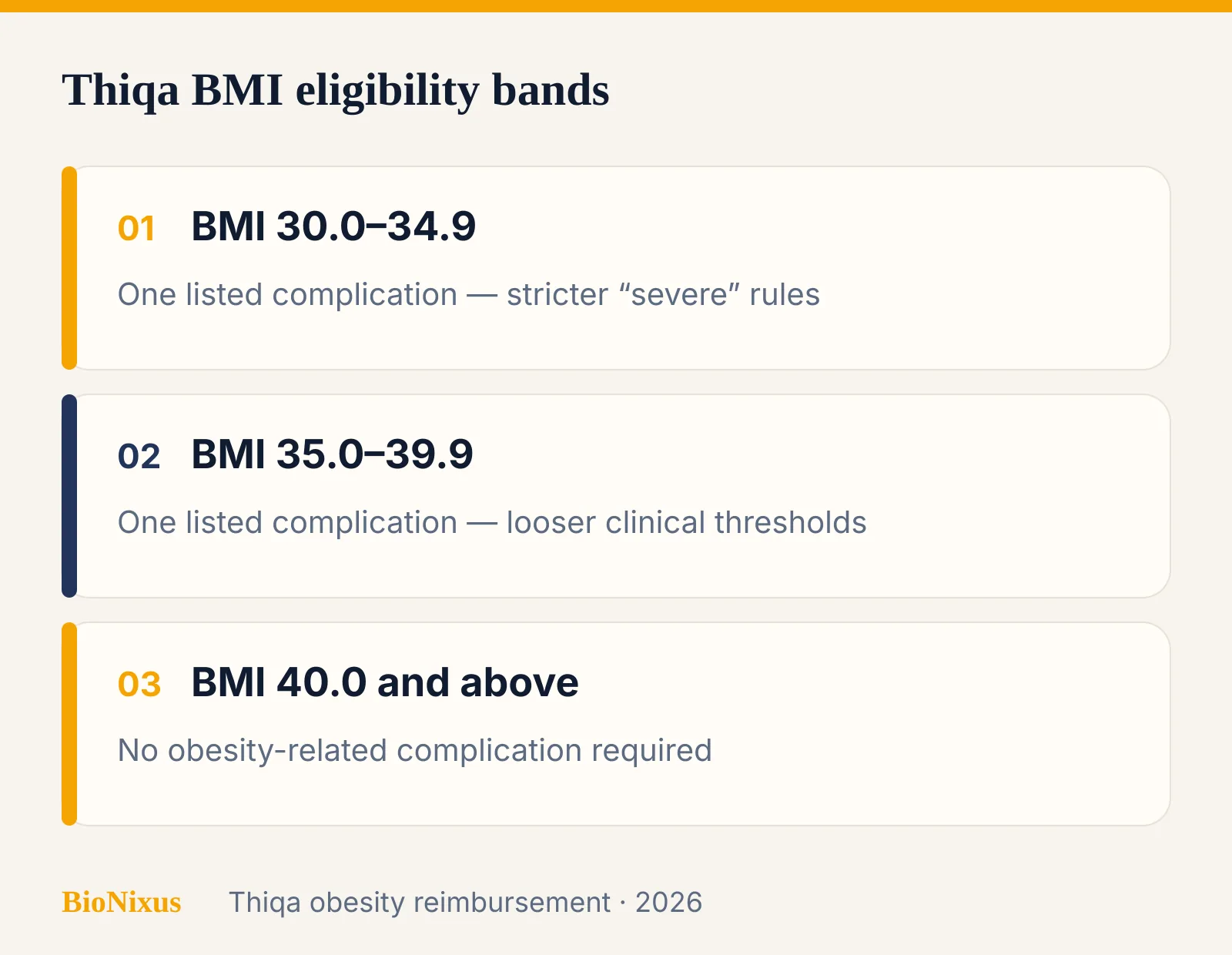
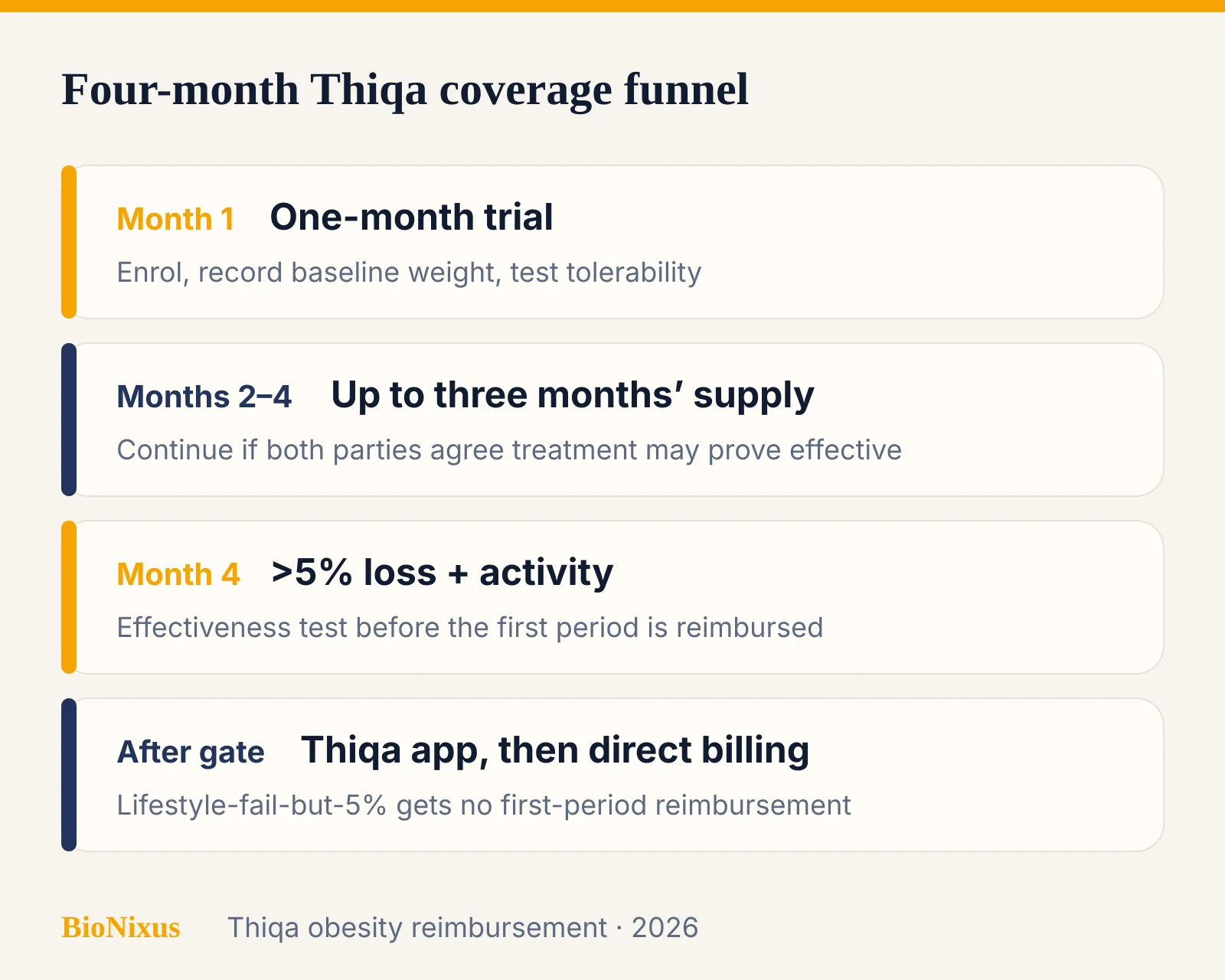
On 11 June 2025 the Department of Health published a Thiqa reimbursement policy for obesity medications, referenced as DoH/Policy/TRP-OMM/HPS/V1/2025 (Department of Health, 11 June 2025). NAVLIN Daily reported the same policy the next day, 12 June 2025 (NAVLIN, 12 June 2025). Quote the policy for the rule. Quote NAVLIN only as a news report of the policy. Do not add a percentage the news line does not carry.
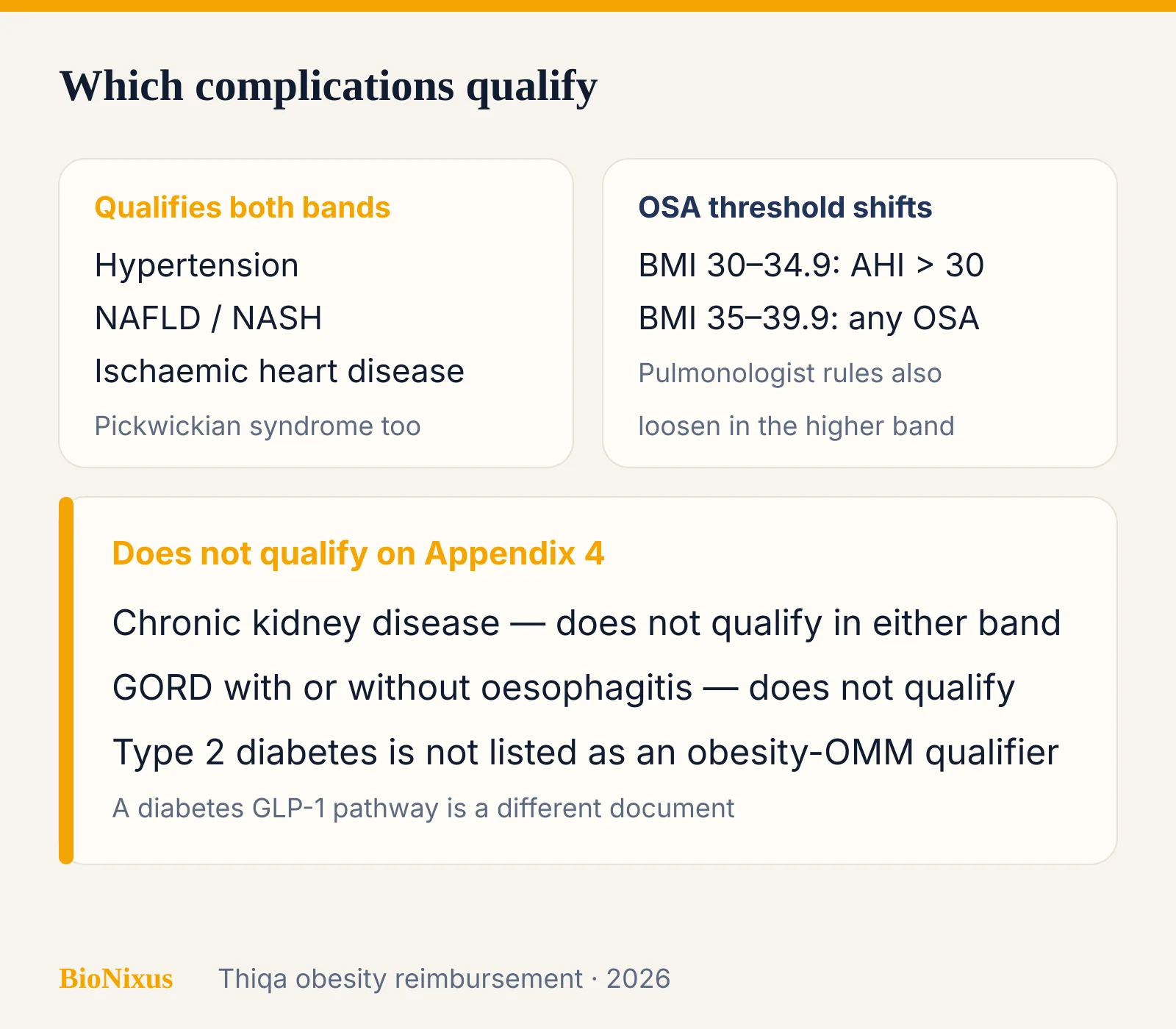
A separate standard, the Standard for Non-Surgical Management of Obesity, is dated February 2025. Its reference is DOH/ST/HPS/Non-Surgical-MO/V1/2025. Appendix 4 sets Thiqa comorbidity criteria (Department of Health, February 2025). The department also hosts that standard under another media identifier, which includes the same appendix (Department of Health, alternate copy). Comorbidity means another illness present at the same time. This page does not restate the appendix. A brief should quote it, not reconstruct it from memory or from another country’s list.
On 19 June 2025 the Department of Health announced a personalised weight-management programme and named Sahatna as the platform for it (Department of Health, 19 June 2025). Sahatna is the platform in that announcement. It is not, by itself, a count of GLP-1 prescriptions. A Saudi ACTION-IO paper is neighbouring-country context only. It is not a Thiqa enrolment figure (ACTION-IO Saudi Arabia).
Obesity figures that do not match
Keep each obesity figure with its source. They are not one ladder you can average into Thiqa demand.
- The Ministry of Health and Prevention’s National Health Survey for 2017–2018 measured 4,971 adults. It found 27.8 percent obese, and 41.8 percent of female Emirati respondents obese (National Health Survey 2017–2018).
- The World Obesity Federation’s March 2024 UAE page repeats the survey’s 27.8 percent, then adds an Emirati rate of 36.9 percent against 26.3 percent for non-Emiratis, an Abu Dhabi figure of 35.9 percent attributed to the ministry in 2023, and 70.8 percent with insufficient activity (World Obesity Federation, March 2024).
- The Federation’s adult report card, using the 2017–2018 survey, lists Emirati men at 32.2 percent obese and Emirati women at 41.8 percent (World Obesity Federation report card). The 41.8 percent for women matches the survey’s figure for female Emirati respondents. The 36.9 percent Emirati figure and the 32.2 percent figure for men are different cuts. Do not blend them.
- The World Health Organization’s adult-obesity indicator is age-standardised and uses a body mass index of 30 or above (World Health Organization; WHO STEPS listing). Our World in Data, using that indicator, puts the UAE at 31.6 percent for 2024 (Our World in Data). An age-standardised rate is not a clinic’s caseload.
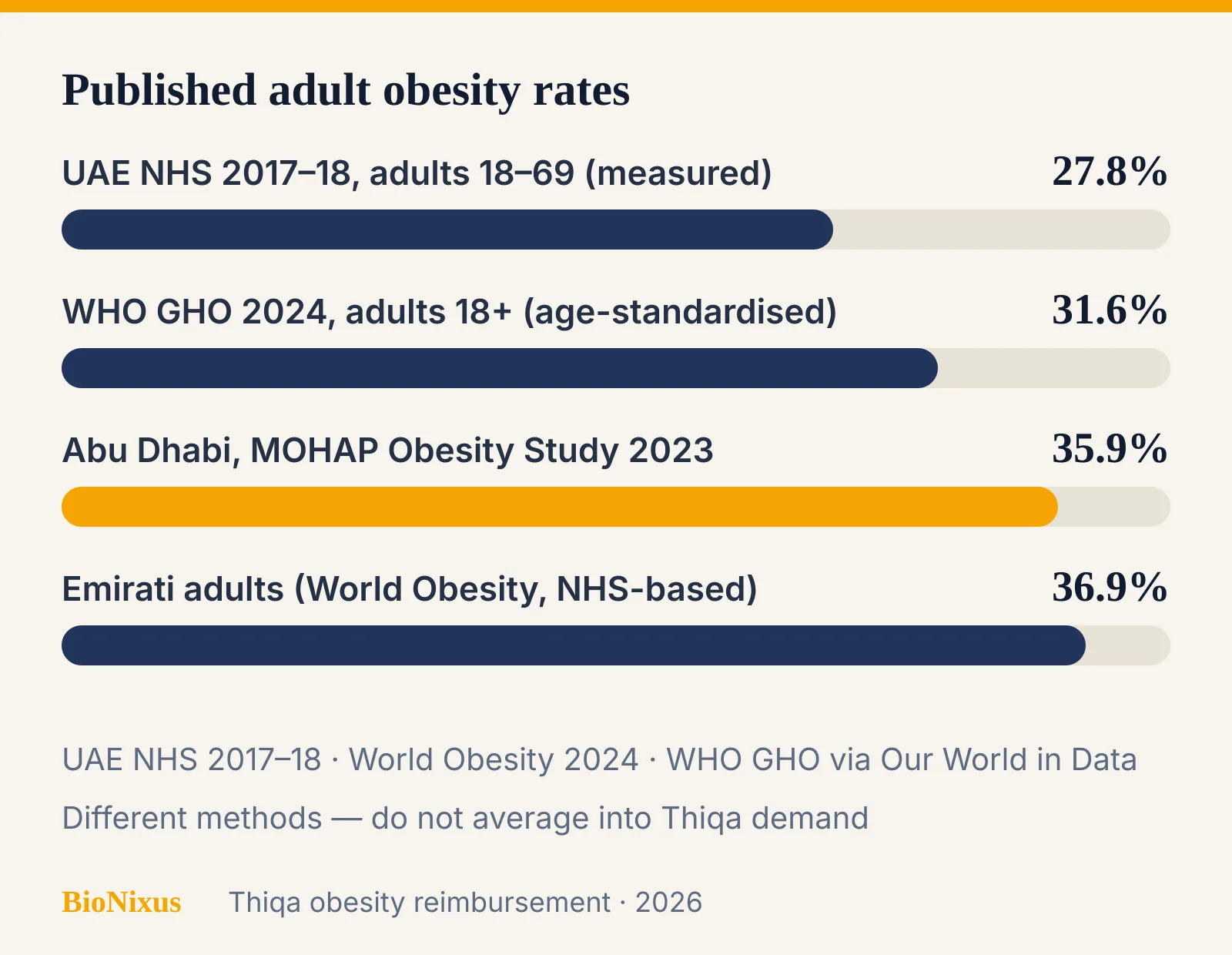
None of these rates is the number of Thiqa members who meet Appendix 4. Grand View Research, 6Wresearch and IMARC sell UAE obesity outlooks. They are not Thiqa enrolment.
How many people live in Abu Dhabi
Population is the backdrop, not the scheme. The Statistics Centre reported 4,135,985 residents in Abu Dhabi in 2024, up 7.5 percent, in a release dated 30 June 2025 (Statistics Centre, 30 June 2025). The census dashboard splits that total into 2,823,340 in the Abu Dhabi region, 986,910 in Al Ain and 325,735 in Al Dhafra (Census 2024 dashboard). Residents include people who are not Thiqa members. The eligibility page talks about nationals and the network. It does not publish a member count on the lines cited here. Do not treat 4,135,985 as the number of people who will receive an obesity medicine.
What a clinic interview has to separate
A useful interview in Abu Dhabi keeps six answers in six cells. The first cell is the document. If the respondent is describing the 11 June 2025 policy, Appendix 4, or the 2022 surgical standard, those are different rules. A surgeon talking about a centre of excellence is not answering the non-surgical reimbursement question.
The second cell is the person. A UAE national on Thiqa, a basic-plan member, and an ABM member can sit in the same waiting room. The managed-entry policy names all three. The eligibility page’s “no annual benefit limit” line is about Abu Dhabi nationals on Thiqa. Do not copy that line onto the other two groups unless their own rule says the same thing.
The third cell is the place. Al Ain and Al Dhafra are inside the emirate and still have their own resident counts. A Dubai clinic is outside this policy. Obesity market research UAE that pools the emirates will hide the Thiqa decision.
The fourth cell is the medicine and the fifth is the platform. Ask which product was prescribed, and whether Sahatna was the route named in the 19 June 2025 announcement. The sixth cell is the outcome the policy cares about, in the policy’s own words. If the respondent cannot point to the clause, record that. Do not fill the blank with a 27.8 percent or a 31.6 percent.
That is the whole of Abu Dhabi GLP-1 coverage as a research problem. The syndicated outlooks do not contain those six cells. The population dashboard does not either.
Questions to put in the brief
Write the decision first. It might be whether a named GLP-1 is paid for a defined patient, or whether Sahatna is the path a clinic actually uses.
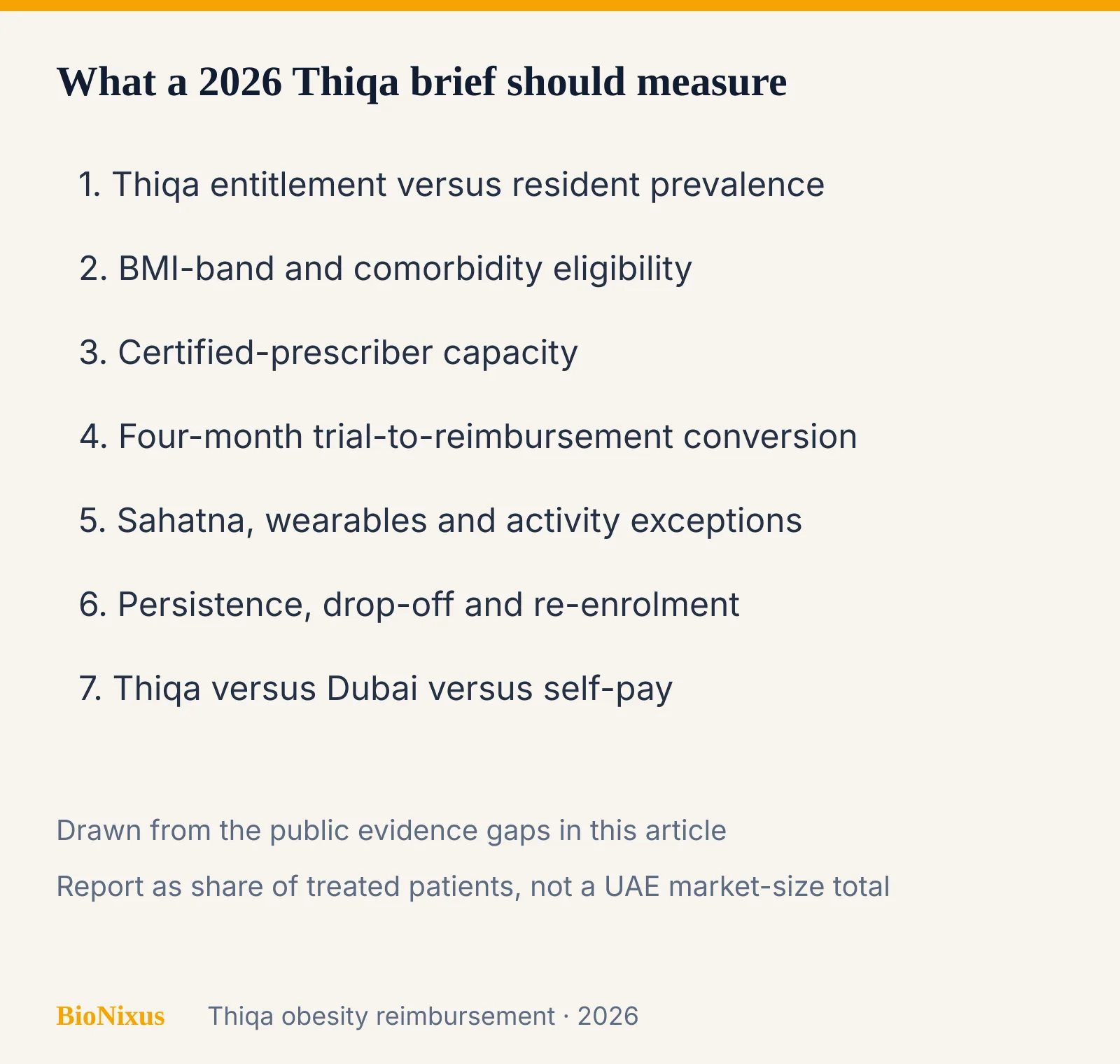
- Which document. The 11 June 2025 policy, Appendix 4 of the February 2025 standard, and the September 2022 surgical standard are different files.
- Which person. Thiqa eligibility, as described for Abu Dhabi nationals, is not the same as a basic plan or an ABM member, even though managed-entry rules name all three.
- Which obesity number you will not use as demand. 27.8 percent, 31.6 percent, 35.9 percent and 36.9 percent stay in separate sentences.
- Which place. Abu Dhabi region, Al Ain and Al Dhafra are different populations inside the emirate. Dubai is a different payer system.
- Which platform. Sahatna is the platform named on 19 June 2025. Ask whether prescriptions in the sample go through it.
- What you will not import. The Saudi ACTION-IO paper is not a Thiqa enrolment figure.
Report results as a share of treated patients who meet the policy you quoted, at named clinics. Ask for Arabic and English instruments. Ask the agency to attach the policy clause it is using, rather than a paraphrase.
How to brief BioNixus
BioNixus is a primary market research firm for pharmaceutical, medical device and healthcare companies. It was founded in 2012. Custom studies are usually priced at $10k–$60k. The firm has 40 client reviews on its public profiles. The line “Guaranteed in writing” covers the agreed scope and timeline. It does not cover what the interviews will find.
Leadership offices are in Sheridan, Wyoming, London, and Sheikh Zayed, Giza. Field offices are in Dubai, Al Khobar, and Salmiya, Kuwait. São Paulo is a field office for LATAM.
To brief a Thiqa study, use the contact form or email admin@bionixus.com. Say which medicine, which clinic and which clause of the policy the study has to test.
References
- Department of Health – Abu Dhabi. Thiqa reimbursement policy for obesity medications. DoH/Policy/TRP-OMM/HPS/V1/2025. 11 June 2025. Source (accessed 15 October 2026).
- Department of Health – Abu Dhabi. Standard for Non-Surgical Management of Obesity. DOH/ST/HPS/Non-Surgical-MO/V1/2025. February 2025. Appendix 4: Thiqa comorbidity criteria. Source (accessed 15 October 2026).
- Department of Health – Abu Dhabi. Abu Dhabi launches unique personalised weight management programme. 19 June 2025. Sahatna is the dedicated platform. Source (accessed 15 October 2026).
- Thiqa. About Thiqa Programme. Abu Dhabi government cover for UAE nationals and similar status; managed by Daman since 2008. Source (accessed 15 October 2026).
- Thiqa. Eligibility. Abu Dhabi nationals: full public and private Thiqa network, UAE and worldwide emergency cover, no annual benefit limit. Source (accessed 15 October 2026).
- Ministry of Health and Prevention, UAE. National Health Survey Report 2017–2018. STEPS; 4,971 measured adults; 27.8% obese; 41.8% of female Emirati respondents obese. Source (accessed 15 October 2026).
- World Obesity Federation. United Arab Emirates: Obesity in numbers (March 2024). NHS 27.8% obese; Emirati 36.9% vs non-Emirati 26.3%; Abu Dhabi 35.9% (MOHAP 2023); 70.8% insufficient activity. Source (accessed 15 October 2026).
- World Obesity Federation. Adult report card — United Arab Emirates. NHS 2017–2018; Emirati men 32.2% obese, women 41.8%. Source (accessed 15 October 2026).
- World Health Organization. GHO indicator NCD_BMI_30A: adult obesity, BMI ≥ 30, age-standardised. Source (accessed 15 October 2026).
- Our World in Data, from WHO GHO (2026). UAE adult obesity 2024: 31.6% (age-standardised, both sexes). Source (accessed 15 October 2026).
- World Health Organization. NCD surveillance: United Arab Emirates STEPS 2017–2018 listing. Source (accessed 15 October 2026).
- Department of Government Enablement – Abu Dhabi / SCAD. Abu Dhabi population 2024: 4,135,985 residents, up 7.5%. 30 June 2025. Source (accessed 15 October 2026).
- Statistics Centre – Abu Dhabi. Census 2024 dashboard: 4,135,985 residents; Abu Dhabi region 2,823,340; Al Ain 986,910; Al Dhafra 325,735. Source (accessed 15 October 2026).
- Department of Health – Abu Dhabi. Policy of Establishing Managed Entry / Risk Sharing Agreements. Applies to Thiqa, basic and ABM members. Source (accessed 15 October 2026).
- Department of Health – Abu Dhabi. Standard for Center of Excellence in Bariatric Surgery. DOH/SD/COE Bariatric Surgery/V1. September 2022. Source (accessed 15 October 2026).
- Department of Health – Abu Dhabi. Standards resource index. Source (accessed 15 October 2026).
- Department of Health – Abu Dhabi. Standard for Non-Surgical Management of Obesity (alternate media id CAFD4FAD88EE4D68B5610CFFE4024DAB), including Appendix 4. Source (accessed 15 October 2026).
- Alfadda AA, et al. ACTION-IO Saudi Arabia. Neighbouring-system context only; not a Thiqa enrolment figure. Source (accessed 15 October 2026).
- Grand View Research. UAE obesity / weight-management outlook pages (syndicated, not Thiqa enrolment). (accessed 15 October 2026).
- 6Wresearch. UAE obesity treatment report pages (syndicated, not primary payer research). (accessed 15 October 2026).
- IMARC Group. UAE weight-management market report pages (syndicated, not Thiqa policy analysis). (accessed 15 October 2026).