This briefing is about Qatar obesity GLP-1 market research. A GLP-1 medicine copies a gut hormone. Doctors use some of them for weight loss. Wegovy is Novo Nordisk’s weekly injection. Its ingredient is semaglutide, at a 2.4 mg dose. Ebn Sina Medical and Novo Nordisk said it was available in Doha on 1 May 2025 (Aamal / Ebn Sina; launch note). Their note says Qatar approved it in October 2024. In September 2026 the Ministry of Public Health approved a once-daily pill in the same drug class for obesity. The public record does not say who stays on treatment. It does not say who pays for the pill. Read this with the healthcare market research hub and the page on the GCC obesity market.
What changed in 2025 and 2026?
Three dated events are in the public record. None of them counts patients on treatment.
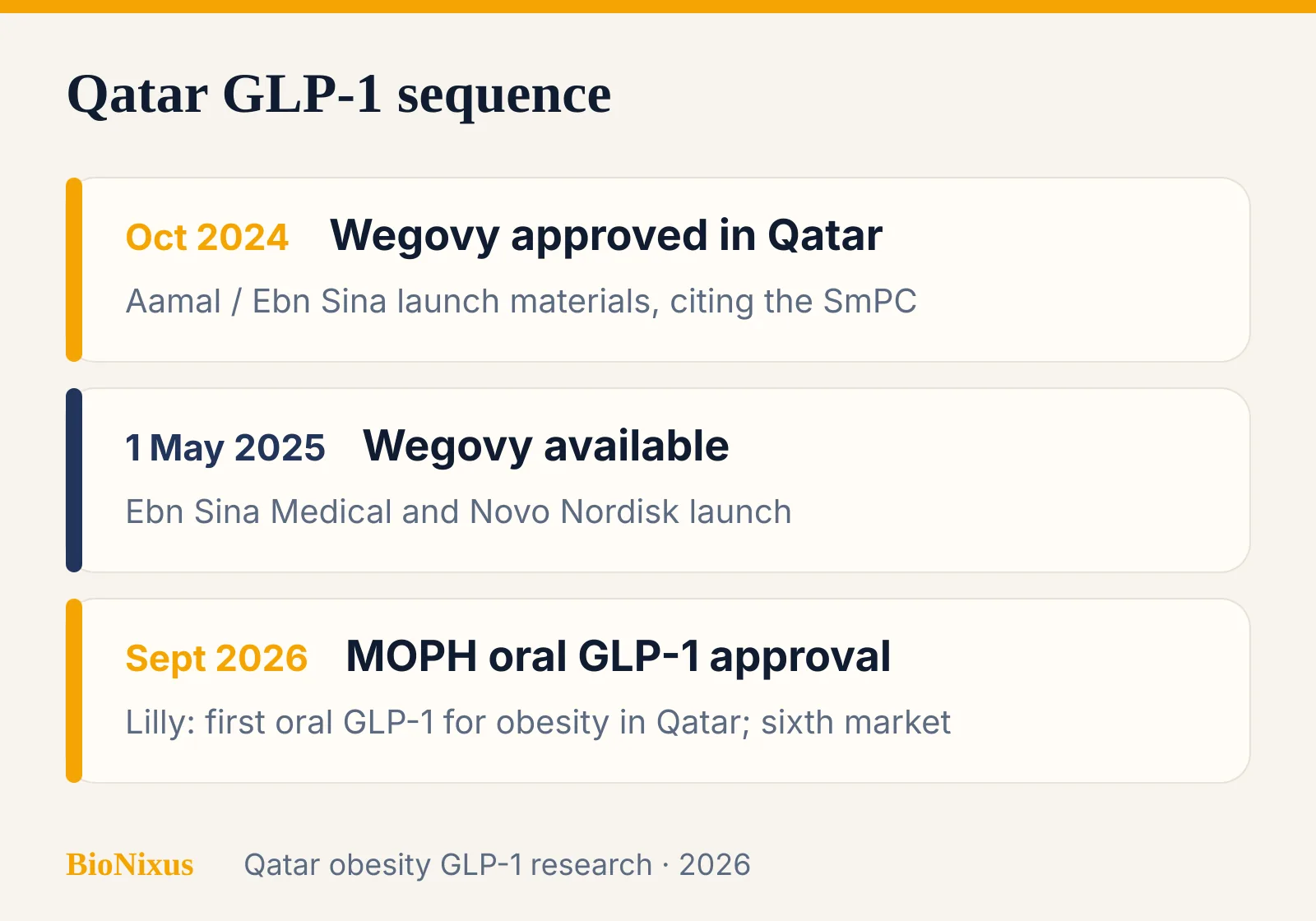
- Ebn Sina Medical, part of Aamal, and Novo Nordisk announced Wegovy on 1 May 2025. The same materials say the product was approved in Qatar in October 2024 (Aamal / Ebn Sina).
- Gulf Times quoted Novo Nordisk’s Qatar general manager, Manvendra Singh. He said Hamad Medical Corporation covers Wegovy for Qatari patients. He put private-market and non-Qatari monthly costs at QR 796 to QR 1,909, depending on the dose (Gulf Times). That quote is not a published Hamad price list.
- Lilly said the Ministry of Public Health approved its once-daily oral GLP-1 for chronic weight management. Lilly called it the first oral GLP-1 approved for obesity in Qatar, and the sixth market for the product (Lilly / ZAWYA). Qatar Tribune published the same approval facts on 28 September 2026 (Qatar Tribune).
Grand View Research, 6Wresearch and Ken Research sell Qatar or GCC obesity reports. A category total is not the same as who leaves a clinic with a pen, who pays cash, or who starts a tablet.
The Ministry’s Pharmacy and Drug Control Department registers manufacturers of medicines. Its Registration and Drug Pricing Section does that work. It also runs an e-system for agents, stores and private pharmacies (Ministry of Public Health). An approval is not the same as a purchase by a public hospital.
How common is obesity in Qatar?
The published figures use different methods. Do not average them. A survey share is not national demand for a medicine.
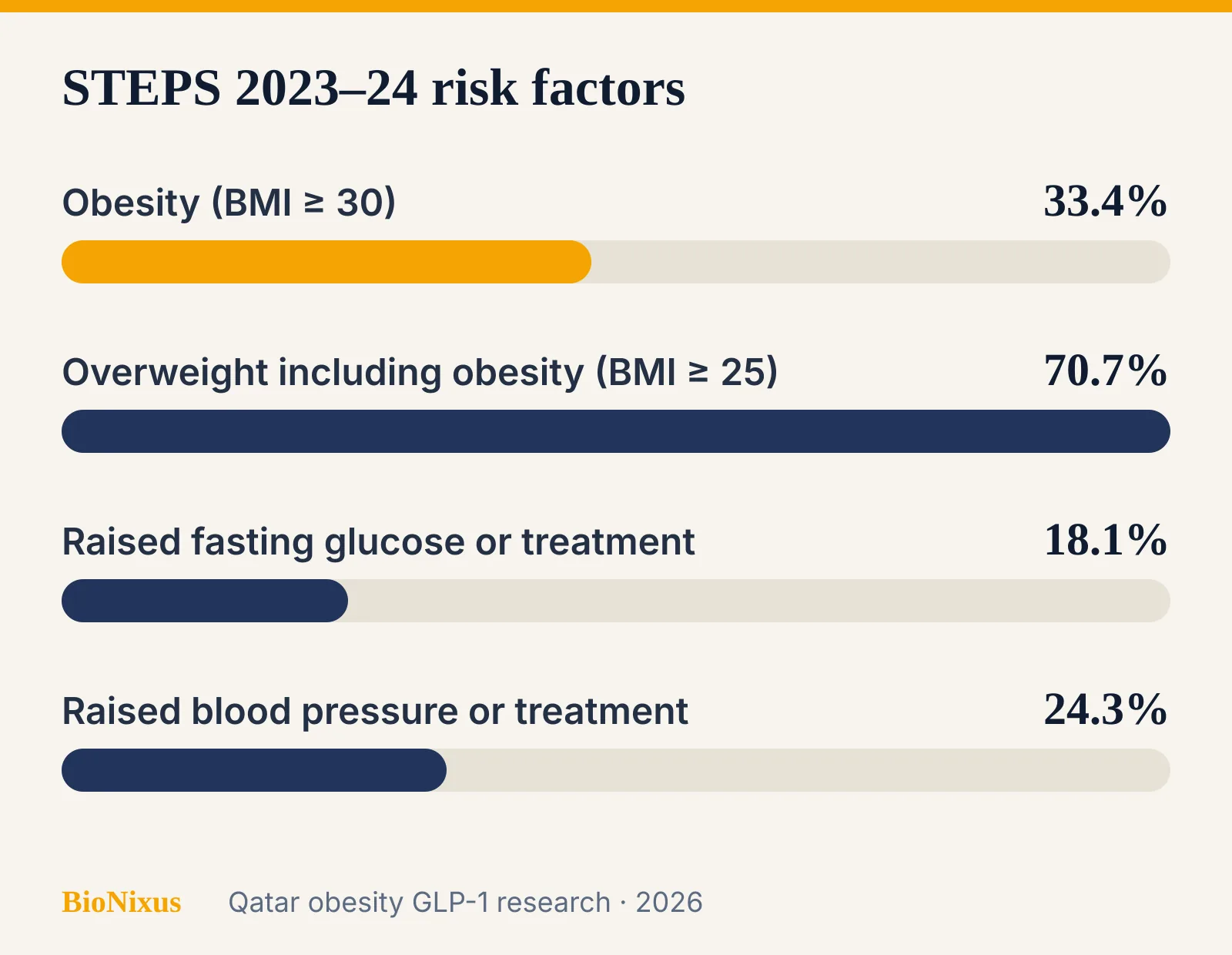
The Ministry of Public Health’s Qatar Health Report 2024 describes the STEPS survey of 2023–24. It ran from May 2023 to January 2024. It selected 8,800 adults aged 18 to 69. The response rate was 84.6%. Obesity, a body mass index of 30 or more, was 33.4%. It was 36.7% in women and 30.4% in men. Overweight including obesity, a body mass index of 25 or more, was 70.7%. Raised fasting glucose, or treatment for it, was 18.1%. Raised blood pressure, or treatment for it, was 24.3% (Qatar Health Report 2024).
A 2026 paper in BMJ Open re-analysed that survey. Al-Thani and colleagues used an unweighted cut of 5,696 adults with a complete body mass index. Obesity in that cut was 37.8%. Among Qatari nationals in the cut it was 40.3% (Al-Thani et al., 2026). That cut is not a replacement for the Ministry figure of 33.4%.
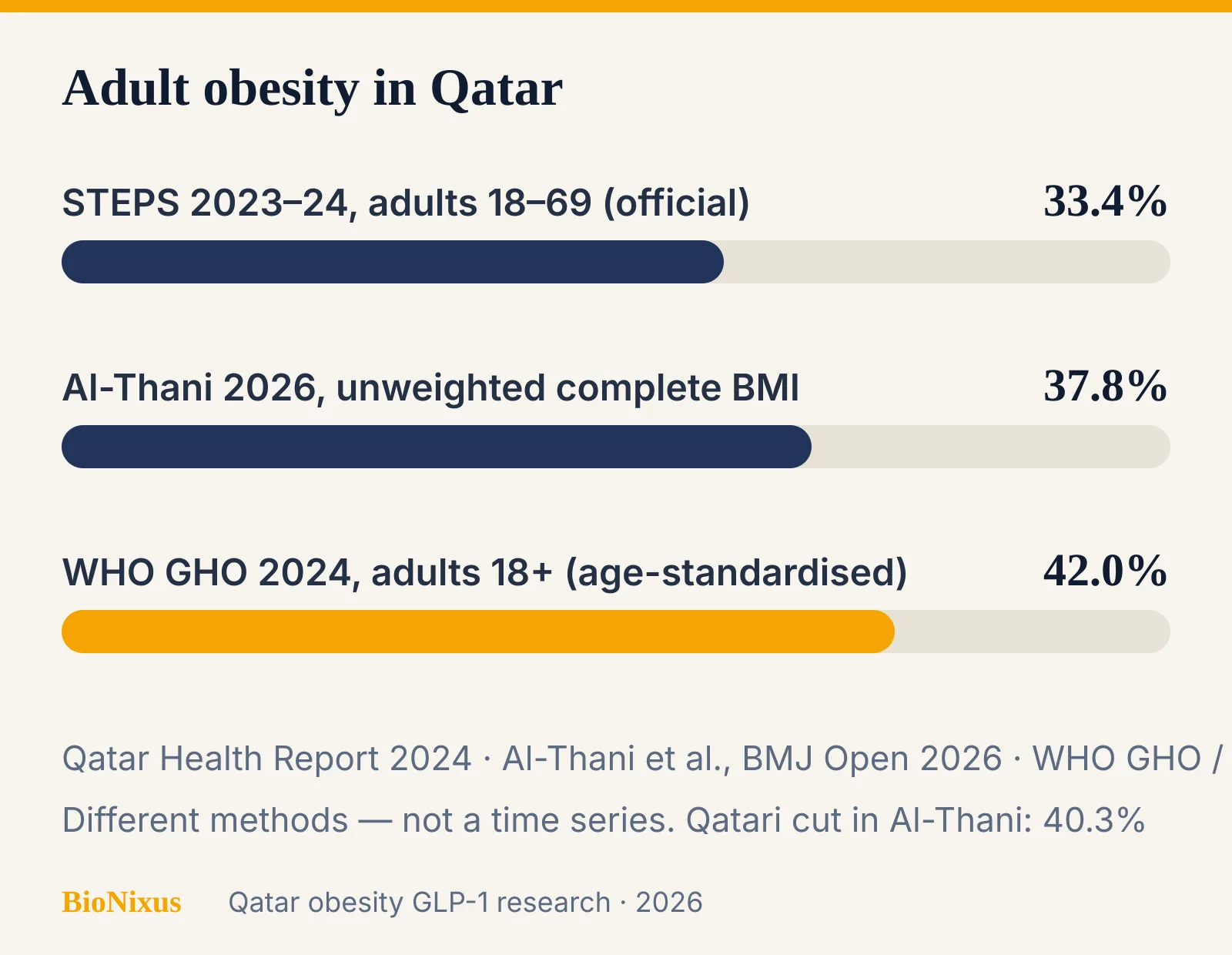
The World Health Organization’s Global Health Observatory publishes an age-standardised estimate of adult obesity. The indicator code is NCD_BMI_30A (WHO). Our World in Data’s 2026 processing of that series puts Qatar’s 2024 figure at 42.04% for adults aged 18 and over (Our World in Data).
The Health Report puts the population in August 2024 at 3,054,365 (Qatar Health Report 2024). The National Planning Council later published 3,214,609 residents at the end of December 2025, up 2.3% from December 2024 (National Planning Council, via Marhaba). In March 2026 the same council published 3,370,611 residents, up 5.6% from 3,190,903 in March 2025 (National Planning Council). The 2020 census counted 340,349 Qataris and 2,505,769 non-Qataris, a total of 2,846,118 (2020 census, via GLMM). A prevalence applied to every resident is not a count of people a public hospital will treat.
Diabetes is a related condition. It is not a sales forecast. STEPS measured raised fasting glucose or treatment at 18.1% in adults aged 18 to 69 (Qatar Health Report 2024). The International Diabetes Federation, as processed by Our World in Data, puts age-standardised diabetes prevalence in adults aged 20 to 79 at 24.6% in 2024 (IDF via Our World in Data). The Atlas country page counts 409.3 thousand adults aged 20 to 79 with diabetes in 2024. It ranks Qatar fifth on age-standardised prevalence among countries and territories in the Atlas (IDF Atlas).
At the Wegovy launch, the Ebn Sina press statement said 41% of adults were obese and 46% of women were obese (Gulf Times). That is a company figure from a launch. It is not the Ministry STEPS table. Do not place it next to 33.4% as if they were one series.
For the wider Gulf picture, see obesity research in Saudi Arabia, Kuwait obesity research, the UAE obesity market and Egypt obesity and GLP-1 research.
What did the Wegovy launch change?
On 1 May 2025, Ebn Sina Medical and Novo Nordisk said Wegovy was available in Qatar. The materials say it was approved in October 2024 (Aamal / Ebn Sina).
Gulf Times reported two access points from that week.
- Hamad Medical Corporation coverage for Qatari patients, as stated by the Novo Nordisk manager (Gulf Times). The paper does not publish a Hamad list, a body-mass cut-off, or a time limit.
- Private-market and non-Qatari monthly costs of QR 796 to QR 1,909 by dose (Gulf Times). Those are launch-week figures quoted by the company. They are not a 2026 ministry list.
On 14 November 2024 the Ministry launched a National Action Plan on Obesity, Diabetes, and Modifiable Risk Factors for Atherosclerotic Cardiovascular Disease for 2024 to 2030. Qatar News Agency reported 58 projects and a target of a 36% reduction in deaths from non-communicable diseases by 2030 (Qatar News Agency). The plan is policy. It is not a decision to pay for a drug.
What did the ministry approve in September 2026?
Lilly said Qatar’s Ministry of Public Health approved a once-daily oral GLP-1 receptor agonist for chronic weight management. Lilly said it is the first oral GLP-1 approved for obesity in Qatar, and the sixth market globally. The release describes adults with obesity, or adults who are overweight and have at least one related condition. It says the tablet can be taken at any time of day, without food and water restrictions (Lilly / ZAWYA). Qatar Tribune published the same approval facts on 28 September 2026 (Qatar Tribune).
That Lilly release, as recorded in the source note, does not name a brand. On 22 September 2026, Al-Sharq reported that a health-sector source said the ministry had registered orforglipron, marketed as Foundayo. The source named strengths of 0.8 mg, 2.0 mg and 5.5 mg, and prices from QAR 849.50 to QAR 1,225.25. The paper said the product had begun to appear in some pharmacies. It is prescription-only, under a specialist in obesity treatment (Al-Sharq). This is a newspaper account of a source. It is not a ministry price circular.
Do not treat the Hamad statement about Wegovy as cover for the tablet. The Gulf Times quote is about Wegovy.
Who pays?
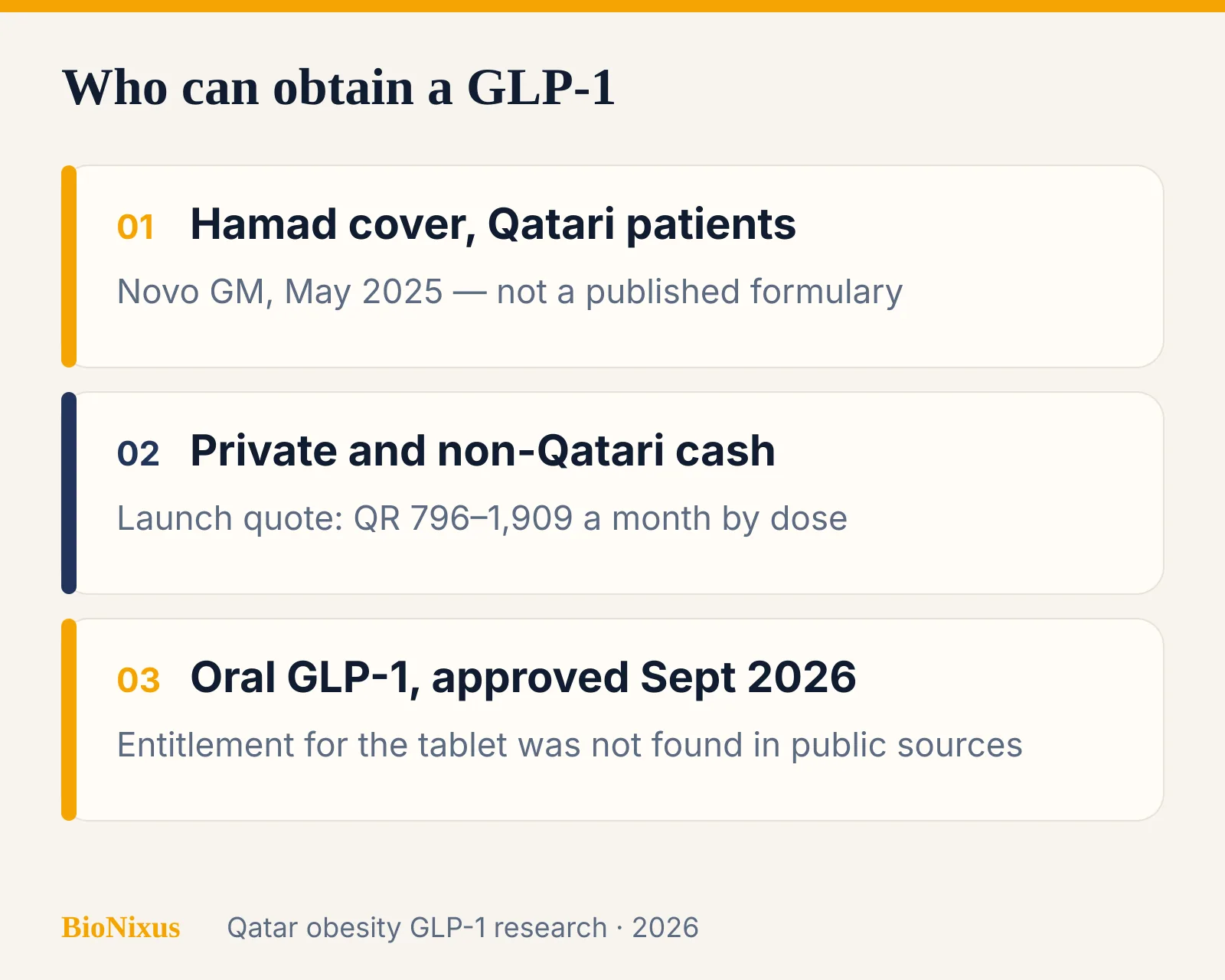
- Hamad, for Qatari patients, for Wegovy. The only published coverage statement in these sources is the May 2025 quote (Gulf Times).
- Private clinics and non-Qatari residents. The same quote put monthly costs at QR 796 to QR 1,909 by dose (Gulf Times). Al-Sharq’s source put Foundayo prices at QAR 849.50 to QAR 1,225.25 (Al-Sharq). Those bands are not the same kind of price. One is a monthly injection range from a company manager. The other is a newspaper price for named tablet strengths.
- Private insurance for non-Qataris. Law No. 22 of 2021 took effect on 4 May 2022. It requires non-Qatari nationals and visitors to hold private health insurance for basic medical services. The earlier SEHA scheme, run by the National Health Insurance Company, was disbanded in 2015 (Clyde & Co). The legal note does not publish an obesity-drug list. Cover for basic services is not proof that a weight-loss GLP-1 is paid for.
The 2020 census counted 340,349 Qataris in a population of 2,846,118 (2020 census). Al-Thani’s cut found obesity of 40.3% among Qatari nationals and 37.8% in the mixed sample (Al-Thani et al., 2026). Nationality and prevalence are different facts.
What should a study ask?
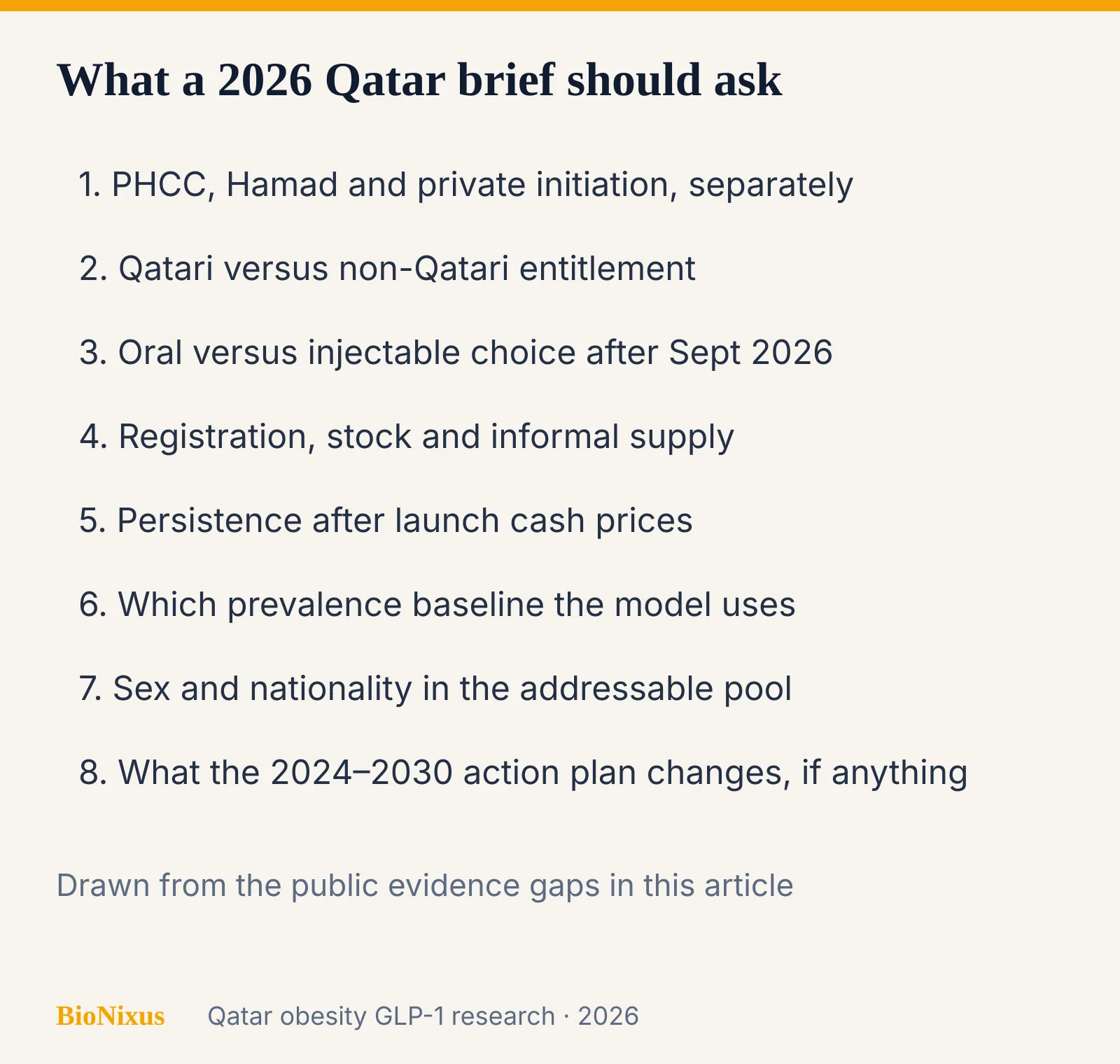
Ask separate questions. Do not turn a prevalence figure into a tender volume.
- Who may start Wegovy, and who may start the oral product?
- Is the Hamad statement limited to Qatari patients and to Wegovy?
- Is the oral product in stock, and who may prescribe it?
- Which baseline is in the model: STEPS 33.4%, the Al-Thani cut of 37.8%, the Qatari cut of 40.3%, or the WHO figure of 42.04%?
- What, if anything, do clinic leads say the 2024–2030 plan changes in listing rules? The plan has 58 projects and a 36% mortality target (Qatar News Agency).
Compare who does obesity market research in Saudi Arabia and obesity market research in Kuwait. Those pages describe other payment systems. Do not copy their answers into Qatar.
How to brief a study
- Which specialties, and in which cities?
- Will results be split by nationality, and by Hamad, primary care and private practice?
- Which prevalence figure will the report use, and why?
- Are the questionnaires in Arabic and English?
Desk reports from Grand View Research, 6Wresearch and Ken Research can frame a category. They are not the pack for a Hamad meeting or an insurer meeting.
How to brief BioNixus
BioNixus is a primary market research firm for pharmaceutical, medical device and healthcare companies. It was founded in 2012. It has served 118 clients in 48 countries. It has run 127 studies so far in 2026. It works with a network of 82,000+ physicians globally and about 3,200 physicians in the Middle East. Custom studies are usually priced at $10k–$60k. Leadership offices are in Sheridan, Wyoming, London EC1V 2NX, and Sheikh Zayed, Giza. Dubai, Al Khobar and Salmiya, Kuwait (Olympia Mall) are field offices. São Paulo is a field office for LATAM. Work in Latin America is covered today from the US office with local consultants.
Use BioNixus when the question is why Qatari and non-Qatari patients, and Hamad, primary-care and private clinicians, act as they do. Each study is built around one decision. The line “Guaranteed in writing” covers the agreed scope, timing and deliverables. It does not cover what the interviews will find. BioNixus has 40 client reviews.
See also healthcare market research in Qatar, the Qatar healthcare market research guide, pharmaceutical market research in Qatar, Qatar market access research and top healthcare market research companies in Qatar.
To brief a study, use the contact form or email admin@bionixus.com.
References
- Ministry of Public Health, Health Information Center. Qatar Health Report 2024 (Brief Report). Doha: March 2025. STEPS 2023–24 (May 2023–January 2024): 8,800 adults aged 18–69 selected, 84.6% response; obesity 33.4% (women 36.7%, men 30.4%); overweight including obesity (BMI ≥ 25) 70.7%; raised fasting glucose or treatment 18.1%; raised blood pressure or treatment 24.3%. Population as of August 2024: 3,054,365. Source (accessed 13 October 2026).
- Al-Thani MH, Loares AM, Nawaz RN, Kokku SB, Mishra A, Jaffery SMH, Malas L, Skaroni I, Abou-Samra AB. Prevalence, risk factors and comorbidities of overweight and obesity among adults in Qatar: a cross-sectional analysis of the 2023 Stepwise Survey. BMJ Open. 2026;16:e110307. doi:10.1136/bmjopen-2025-110307. Unweighted secondary analysis of 5,696 adults with complete BMI: obesity 37.8%; Qatari nationals 40.3%. Source (accessed 13 October 2026).
- World Health Organization. Global Health Observatory: Obesity among adults, BMI ≥ 30 kg/m² (age-standardized estimate), indicator NCD_BMI_30A. Source (accessed 13 October 2026).
- Our World in Data, from World Health Organization – Global Health Observatory (2026). Obesity among adults, BMI ≥ 30 kg/m² (age-standardized estimate), adults 18+, both sexes, Qatar 2024: 42.04%. Source (accessed 13 October 2026).
- Our World in Data, from International Diabetes Federation (Diabetes Atlas) via World Bank (2026). Age-standardised diabetes prevalence, adults 20–79, Qatar 2024: 24.6%. Source (accessed 13 October 2026).
- International Diabetes Federation. IDF Diabetes Atlas country page for Qatar. Adults 20–79 with diabetes in 2024: 409.3 thousand; age-standardised prevalence 24.6%; fifth-highest prevalence globally among countries and territories in the Atlas. Source (accessed 13 October 2026).
- Aamal Company Q.P.S.C. / Ebn Sina Medical. Ebn Sina Medical strengthened commitment to healthcare innovation through its continued partnership with Novo Nordisk to bring Wegovy (semaglutide 2.4 mg) to Qatar. Doha, 1 May 2025. Footnote 1: Wegovy summary of product characteristics, approved in Qatar October 2024. Source (accessed 13 October 2026).
- Ebn Sina Medical and Novo Nordisk. Press release PDF: availability of Wegovy (semaglutide 2.4 mg) in Qatar. Doha, 1 May 2025. Source (accessed 13 October 2026).
- Aguilar J. Ebn Sina Medical launches weight loss drug in Qatar. Gulf Times. 2 May 2025. Quotes Novo Nordisk Qatar general manager Manvendra Singh: Hamad Medical Corporation coverage for Qatari patients; private-market and non-Qatari monthly costs QR 796 to QR 1,909 by dose. Ebn Sina press statement cited 41% adult obesity and 46% among women — a different figure from official STEPS. Source (accessed 13 October 2026).
- Eli Lilly (via ZAWYA). Qatar MOPH approves Lilly’s oral GLP-1 treatment for obesity. Press release. Once-daily oral GLP-1 receptor agonist approved for chronic weight management; first oral GLP-1 approved for obesity in Qatar; sixth market globally. Adults with obesity, or overweight with at least one related comorbid condition. Can be taken at any time of day without food and water restrictions. Source (accessed 13 October 2026).
- Qatar Tribune. MoPH okays Lilly’s oral GLP-1 treatment for obesity in Qatar. 28 September 2026. Same approval facts as the Lilly release: first oral GLP-1 for obesity in Qatar; sixth market globally. Source (accessed 13 October 2026).
- Al-Sharq. A health-sector source told the paper that the Ministry of Public Health had registered orforglipron, marketed as Foundayo, in 0.8 mg, 2.0 mg and 5.5 mg strengths, with prices from QAR 849.50 to QAR 1,225.25, and that it had begun to appear in some pharmacies. 22 September 2026. Prescription-only, under a specialist in obesity treatment. This is a newspaper account of a source, not a Ministry price circular. Source (accessed 13 October 2026).
- Qatar News Agency. MOPH launches a groundbreaking National Action Plan to tackle obesity, diabetes, and ASCVD risks. 14 November 2024. National Action Plan on Obesity, Diabetes, and Modifiable Risk Factors for Atherosclerotic Cardiovascular Disease 2024–2030: 58 projects; target of a 36% reduction in NCD mortality by 2030. Source (accessed 13 October 2026).
- Marhaba, quoting the National Planning Council. Qatar’s population surpasses 3.2 million by end of 2025: 3,214,609 persons at the end of December 2025, up 2.3% from December 2024. 5 January 2026. Source (accessed 13 October 2026).
- Marhaba, quoting the National Planning Council. Qatar population hits 3.37 million in March 2026: 3,370,611, up 5.6% year on year from 3,190,903 in March 2025. 28 April 2026. Source (accessed 13 October 2026).
- Gulf Labour Markets, Migration, and Population (GLMM), from Planning and Statistics Authority census 2020. Population by nationality: 340,349 Qataris and 2,505,769 non-Qataris; total 2,846,118. Source (accessed 13 October 2026).
- Ministry of Public Health. Business services: Pharmacy and Drug Control Department services include registration of manufacturers of pharmaceutical products (Registration & Drug Pricing Section) and the Pharmacy and Drug Control e-system for pharmaceutical agents, facilities, stores and private pharmacies. Source (accessed 13 October 2026).
- Clyde & Co (ELA). New mandatory health insurance system introduced in Qatar. Law No. 22 of 2021 took effect on 4 May 2022. Non-Qatari nationals and visitors must hold private health insurance covering basic medical services. The earlier SEHA / National Health Insurance Company scheme was disbanded in 2015. The article does not publish an obesity-drug formulary. Source (accessed 13 October 2026).
- Grand View Research. Qatar / GCC obesity and weight-management report pages that rank for Qatar obesity and GLP-1 queries. (accessed 13 October 2026).
- 6Wresearch. Qatar and GCC obesity treatment and anti-obesity drug report pages. (accessed 13 October 2026).
- Ken Research. GCC / Qatar obesity and weight-management report pages that appear for the same queries. (accessed 13 October 2026).