
A launch team that needs Saudi health insurance payer research is asking who will pay a private prescription. This page sits on healthcare market research, next to healthcare market research in Saudi Arabia and the directory of health insurers in Saudi Arabia. The Council of Health Insurance, CHI, runs the private-insurance rules. The Insurance Authority watches the insurance companies. Those are different offices. A premium total does not tell you whether a named drug will be paid.
Two councils, two jobs
CHI’s own law is the Cooperative Health Insurance Law, issued by Royal Decree M/10 on 12 August 1999 (Royal Decree M/10). The policy page says the Essential Benefit Package has applied from 1 October 2022 (CHI policy page). The updated package itself is dated to that same day (Essential Benefit Package). The package is the minimum cover. It is not a promise that every new medicine is included.
The Insurance Authority is a different body. Its FAQ says it has been the authorised insurance regulator from 23 November 2023, under Council of Ministers Resolution 85 of 15 August 2023 (Insurance Authority FAQ). The Authority’s about page dates the same resolution as 28/1/1445 H (Insurance Authority). Quote each page’s date as that page prints it. Do not merge the two lines into a third date. The Ministry of Health, writing about the Authority’s stand at the Global Health Exhibition 2025, mentioned 23 licensed health writers (Ministry of Health, 2025). That is an exhibition note. It is not a list of who pays for one drug.
A 2024 country note from the Pharmaceutical Pricing and Reimbursement Information network describes the health system and how medicines are priced (PPRI 2024). Read it for the public pricing path. Do not read it as a CHI enrolment file. The Saudi Food and Drug Authority is the marketing-authorisation authority for medicines (SFDA). Registration means the product may be sold. It does not mean a private insurer will pay. NUPCO, the National Unified Procurement Company, was founded in 2009 and is fully owned by the Public Investment Fund (NUPCO). NUPCO buys for government hospitals. A NUPCO award is not a CHI claim.
Saudi Vision 2030’s Health Sector Transformation Program is the reform frame (Vision 2030 health programme). The programme page does not name which insurer will list a new medicine. Grand View Research and IMARC sell syndicated outlooks for Saudi healthcare and insurance. Use them as background. They are not a formulary interview.
How many people are insured
Keep the beneficiary notes in the order CHI published them. On 7 January 2025, CHI said more than 13 million people had private health insurance (CHI, 7 January 2025). On 27 October 2025, CHI said 14 million people had private health insurance in the third quarter of 2025 (CHI, 27 October 2025). Those are two dates. Do not average them, and do not turn either number into the number of people who will start one drug.
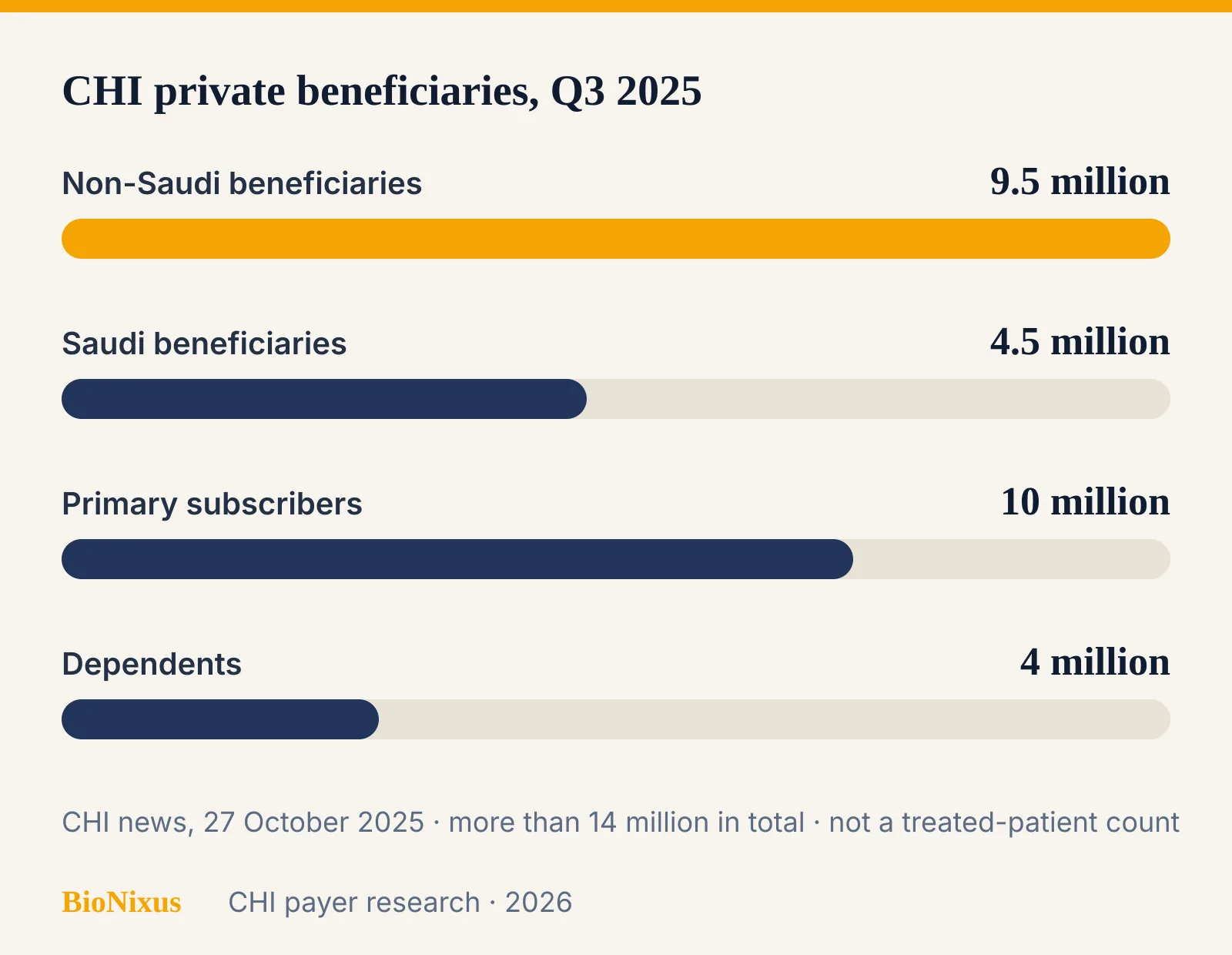
CHI’s research library lists a beneficiaries report last updated on 24 September 2025 (CHI research library). Its statistics page, with views of insured people and Nafis claims, was updated on 10 August 2025 (CHI statistics). Nafis, or NPHIES, is the exchange those claims move through. Use the library date and the statistics date as freshness checks. They are not a second headcount.
The resident population is a different file again. The General Authority for Statistics put mid-2024 residents at 35.3 million (GASTAT, 2024). The national platform prints the same estimate as 35,300,280 (my.gov.sa). That is one population figure from two pages, not two populations. It is also larger than the insured count, because not every resident is in private insurance. GASTAT counted 516 hospitals in 2024 (GASTAT hospitals, 2024). A hospital count is not an insured-patient count.
What the drug list is
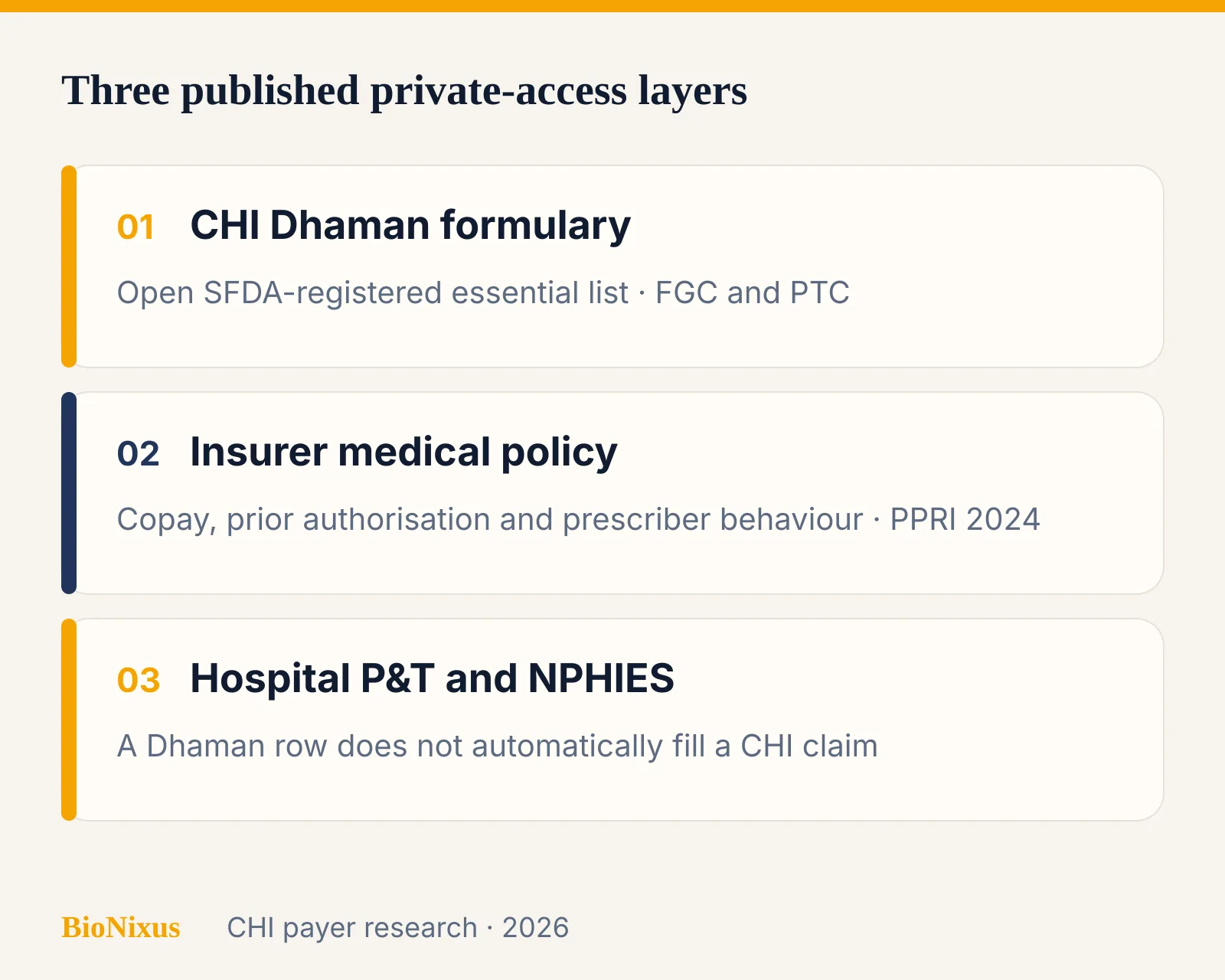
The CHI Dhaman formulary is the Council’s drug list. CHI describes it as an open list of essential medicines that the SFDA has registered (CHI Dhaman formulary). An Arabic page of the same list is published as دليل ضمان للأدوية (Arabic Dhaman page). Open, here, means the list is built from registered medicines. It does not mean every registered medicine is paid at every hospital without a further rule.
CHI also runs an Insurance Drug Formulary programme. Requests to add a product go to IDF@chi.gov.sa (CHI addition requests). A user guide for the Daman Drug Formulary master spreadsheet is dated 24 March 2025 (CHI spreadsheet guide, 24 March 2025). Daman, in this label, is the CHI spelling of the same formulary programme. Read the guide for how the sheet is organised. Do not treat a row in the sheet as proof that a claim was paid last month.
An insurer can still have its own medical rules after a drug is on the CHI list. Bupa Arabia’s financial statements for the year ended 31 December 2024 report medical-only gross written premium (Bupa Arabia, 2024). That line tells you Bupa reports medical business on its own. It does not tell you Bupa’s rule for a named molecule. Ask the insurer. The CHI list, the insurer’s rule and the hospital committee are three questions.
What happens when a claim is sent
NPHIES is the unified health-insurance exchange CHI runs with the National Center for Health Information (NPHIES). CHI also publishes an Arabic page for the same programme, منصة نفيس (Arabic NPHIES page). The implementation guide covers eligibility, prior authorisation and claims (NPHIES guide). Prior authorisation means the insurer is asked to approve a treatment before it is given. A hospital that wants CHI accreditation has to connect to NPHIES (CHI accreditation).
A failed claim can fail at eligibility, at authorisation, or at payment. The guide names those steps. It does not say which step stops a particular drug. That is what payer interviews are for. Ask which code the hospital sends, who answers, and how long the answer takes. Do not infer the answer from a premium table.
Premiums are not prescriptions
The Insurance Authority’s Saudi Insurance Market Report 2024 puts health gross written premium at SAR 42,248.5 million (Insurance Authority, 2024 report). Gross written premium is the premium insurers recorded. It is not the amount paid to hospitals for one medicine, and it is not a patient count. The Authority’s news note of 7 May 2025 is the public pointer to that report (Insurance Authority, 7 May 2025). The annual-publications page lists both the 2025 and the 2024 market reports (Insurance Authority publications). Use the report that matches the year you cite.
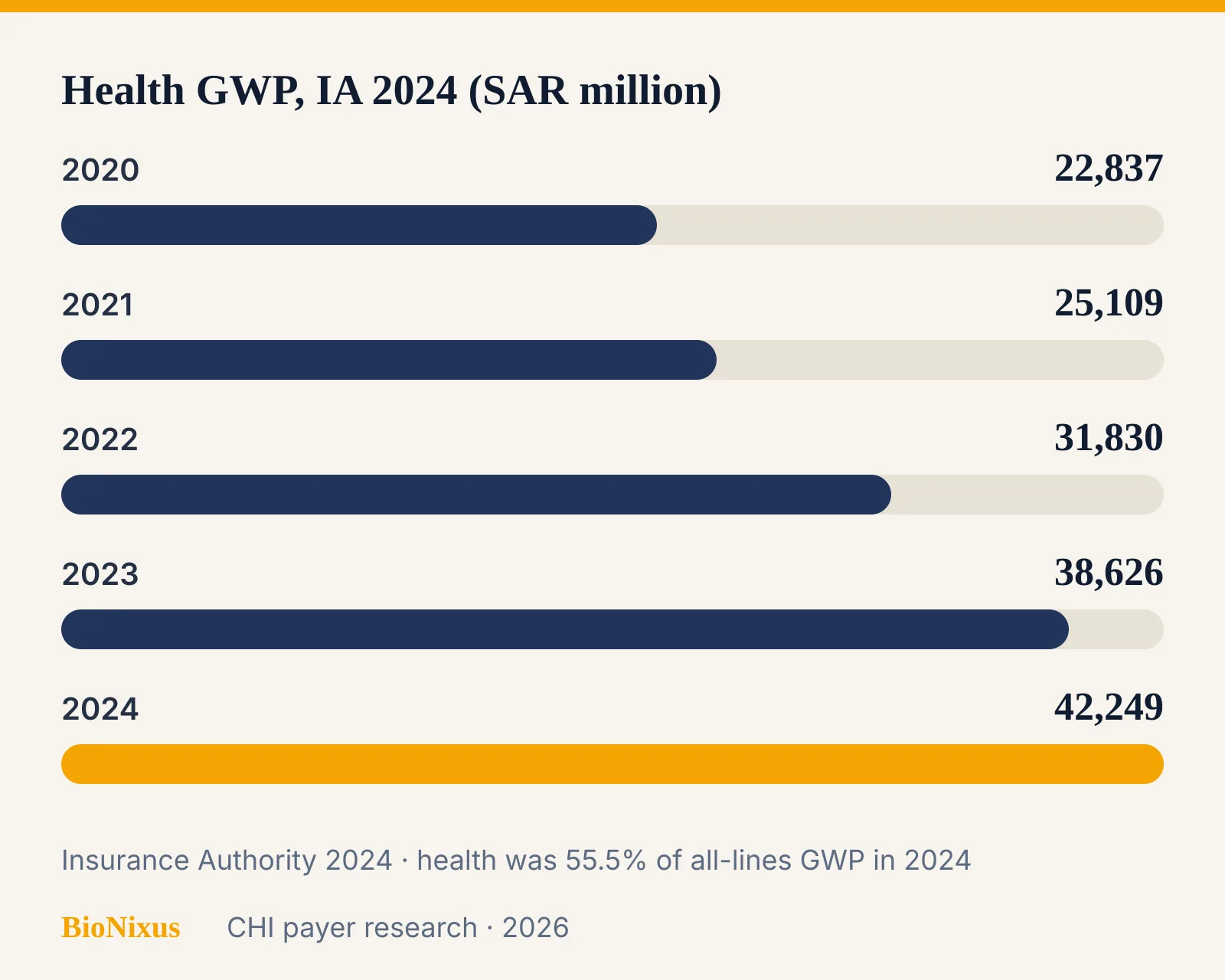
On 31 July 2026 the Saudi Press Agency reported the Insurance Authority saying gross written premium exceeded SAR 84 billion (Saudi Press Agency, 31 July 2026). The agency note does not label that 84 billion as health only. Do not subtract it from the 2024 health figure and call the gap a forecast. They are different statements, on different dates.
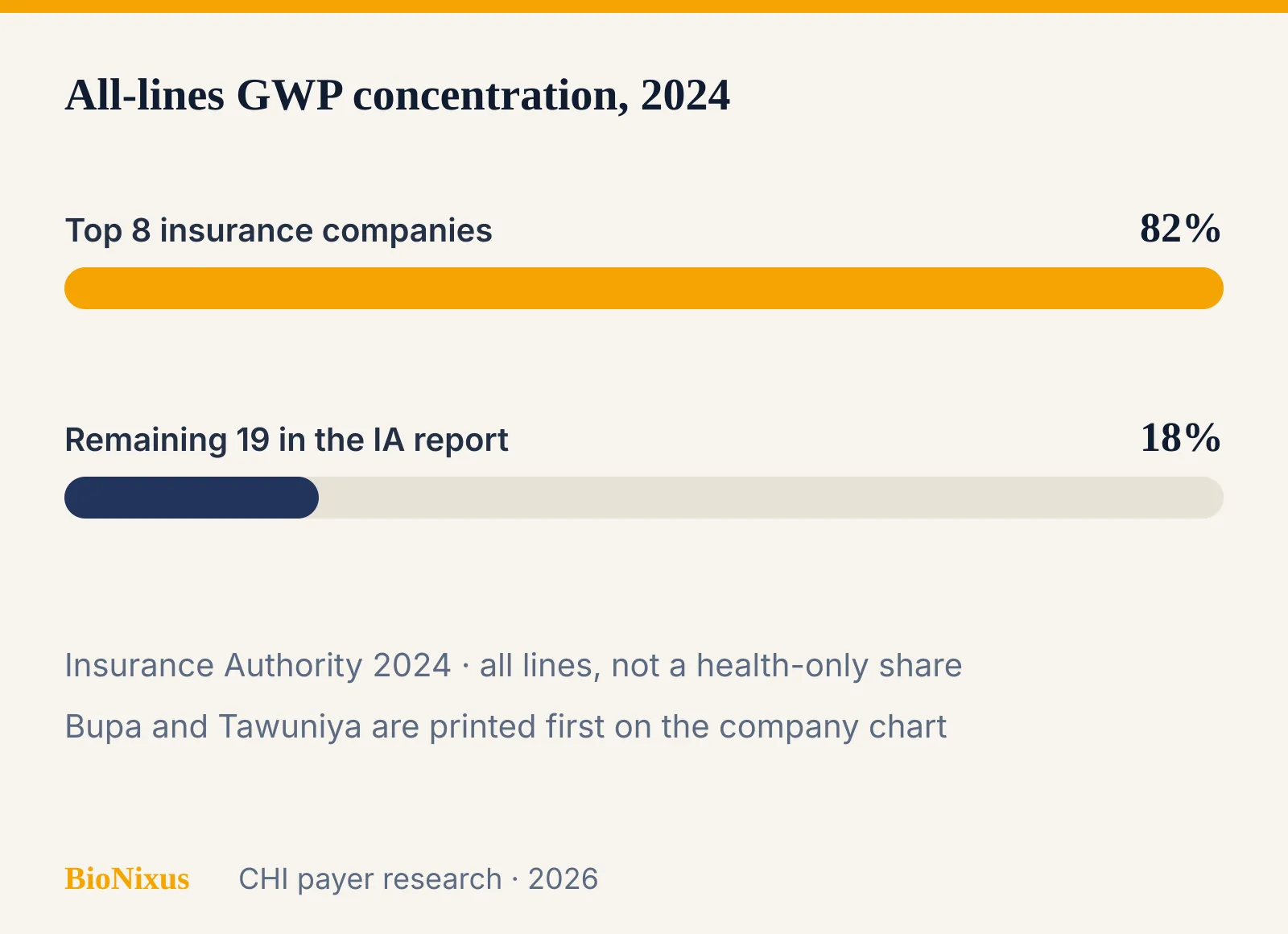
A model that starts from 14 million beneficiaries, or from SAR 42,248.5 million, and ends at “patients on our drug” has skipped the list, the insurer rule and the claim. Those three are the study.
Questions to put in the brief
Write the decision in one line before you pick a sample. The decision might be a Dhaman addition, a change to an insurer’s medical rule, or a listing at a hospital that bills CHI.
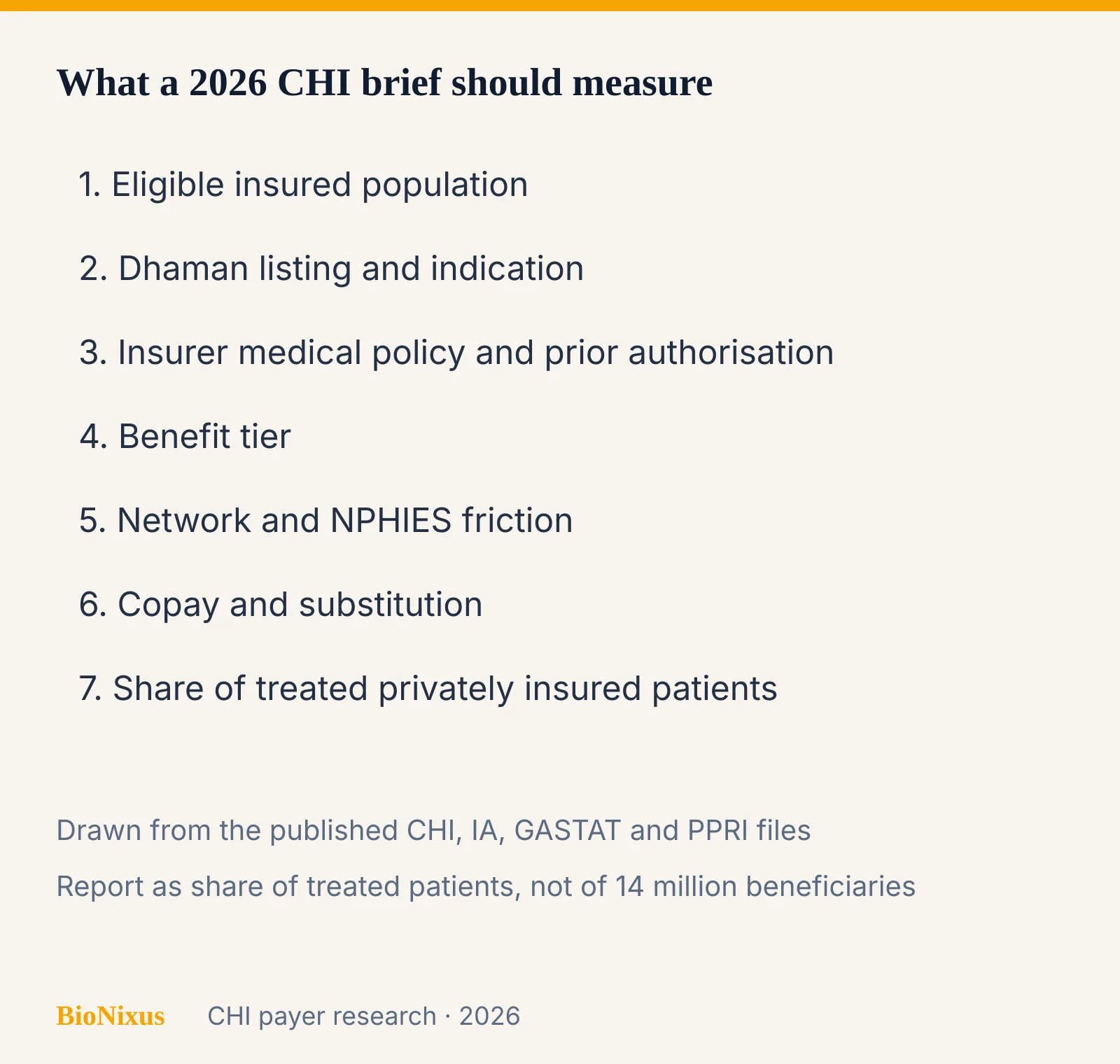
- Which people. Say whether you mean the January 2025 note, the October 2025 note, or both. Do not call either note the whole population of 35.3 million.
- Which list. Ask if the scientific name is on the CHI Dhaman formulary, and which edition of the spreadsheet the payer is using.
- Which insurer rule. A place on the CHI list is not the same as a Bupa medical rule, or any other writer’s rule. The exhibition note’s 23 writers are not that rule.
- Which claim step. Ask where the NPHIES transaction stops: eligibility, prior authorisation, or payment.
- Which hospital. The 516 hospitals are not the sampling frame. Name the hospitals that bill the insurers in the brief.
- Which public path you will leave out. NUPCO and SFDA registration are real gates. They are not a private claim.
Report the result as a share of treated patients who are privately insured, at named hospitals. Ask for Arabic and English instruments. Ask which CHI page and which date the agency will quote.
How to brief BioNixus
BioNixus is a primary market research firm for pharmaceutical, medical device and healthcare companies. It was founded in 2012. Custom studies are usually priced at $10k–$60k. The firm has 40 client reviews on its public profiles. The line “Guaranteed in writing” covers the agreed scope and timeline. It does not cover what the interviews will find.
Leadership offices are in Sheridan, Wyoming, London, and Sheikh Zayed, Giza. Field offices are in Dubai, Al Khobar, and Salmiya, Kuwait. São Paulo is a field office for LATAM.
To brief a payer study, use the contact form or email admin@bionixus.com. Say which insurer, which list and which decision the study has to answer.
References
- CHI. 14 million private-insurance beneficiaries in Q3 2025. News, 27 October 2025. Source (accessed 17 October 2026).
- CHI. More than 13 million private-insurance beneficiaries. News, 7 January 2025. Source (accessed 17 October 2026).
- CHI. CHI Drug Formulary (Dhaman). Open SFDA-registered essential-drug list. Source (accessed 17 October 2026).
- CHI. دليل ضمان للأدوية. Arabic Dhaman formulary page. Source (accessed 17 October 2026).
- CHI. Insurance Drug Formulary (IDF) programme. Addition requests to IDF@chi.gov.sa. Source (accessed 17 October 2026).
- CHI. Daman Drug Formulary Master Excel Sheet User Guide, 24 March 2025. Source (accessed 17 October 2026).
- CHI. Cooperative Health Insurance Policy page. Essential Benefit Package from 1 October 2022. Source (accessed 17 October 2026).
- CHI. Updated Essential Benefit Package, effective 1 October 2022. Source (accessed 17 October 2026).
- CHI. Cooperative Health Insurance Law. Royal Decree M/10, 12 August 1999. Source (accessed 17 October 2026).
- CHI. Request for accreditation of a health-service provider. NPHIES integration required. Source (accessed 17 October 2026).
- CHI. NPHIES. Unified health-insurance exchange with the National Center for Health Information. Source (accessed 17 October 2026).
- CHI. منصة نفيس. Arabic NPHIES programme page. Source (accessed 17 October 2026).
- NPHIES. Healthcare Financial Services Implementation Guide. Eligibility, prior authorisation, claims. Source (accessed 17 October 2026).
- CHI. Research Library. Beneficiaries Report last updated 24 September 2025. Source (accessed 17 October 2026).
- CHI. Statistics & Indicators. Insured-individual and Nafis-claim views. Updated 10 August 2025. Source (accessed 17 October 2026).
- Insurance Authority. The Saudi Insurance Market Report 2024. Health GWP SAR 42,248.5 million. Source (accessed 17 October 2026).
- IA. Insurance Authority Issues the Saudi Insurance Market Report of 2024. News, 7 May 2025. Source (accessed 17 October 2026).
- IA. Annual publications. Lists the 2025 and 2024 insurance-market reports. Source (accessed 17 October 2026).
- Saudi Press Agency. Insurance Authority: GWP exceed SAR 84 billion. 31 July 2026. Source (accessed 17 October 2026).
- IA. FAQs. Authorised insurance regulator from 23 November 2023 (CM Resolution 85, 15 August 2023). Source (accessed 17 October 2026).
- IA. About the Authority. Established by Council of Ministers Resolution No. 85, 28/1/1445 H. Source (accessed 17 October 2026).
- Ministry of Health. Insurance Authority at the Global Health Exhibition 2025. 23 licensed health writers. Source (accessed 17 October 2026).
- Bupa Arabia. Consolidated financial statements, year ended 31 December 2024. Medical-only GWP. Source (accessed 17 October 2026).
- PPRI. Healthcare system and pharmaceutical pricing in Saudi Arabia (2024). Source (accessed 17 October 2026).
- GASTAT. Population Estimates Statistics 2024. Mid-2024 residents: 35.3 million. Source (accessed 17 October 2026).
- National Platform (my.gov.sa). Reports and Statistics. Population in 2024: 35,300,280. Source (accessed 17 October 2026).
- GASTAT. Healthcare Establishments and Workforce Statistics 2024. 516 hospitals. Source (accessed 17 October 2026).
- NUPCO. Overview. Founded 2009; fully owned by the Public Investment Fund. Source (accessed 17 October 2026).
- Saudi Food and Drug Authority. Home. Marketing-authorisation authority for medicines. Source (accessed 17 October 2026).
- Saudi Vision 2030. Health Sector Transformation Program. Source (accessed 17 October 2026).
- Grand View Research. Saudi Arabia healthcare / pharmaceutical outlook pages. Syndicated sizing. (accessed 17 October 2026).
- IMARC Group. Saudi Arabia healthcare / insurance market report pages. Syndicated outlooks. (accessed 17 October 2026).