A company planning a cancer-drug launch needs CAR-T Saudi Arabia market research before it treats a national list as demand. This page sits on healthcare market research in Saudi Arabia. It uses published files only. CAR-T is a treatment that changes a patient’s own immune cells so they can attack a blood cancer. An antibody-drug conjugate, often called an ADC, joins a targeted antibody to a cell-killing drug. A bispecific antibody can bind two targets at once. Those three products can share a hospital, and they still need different questions.
What the published files can tell you
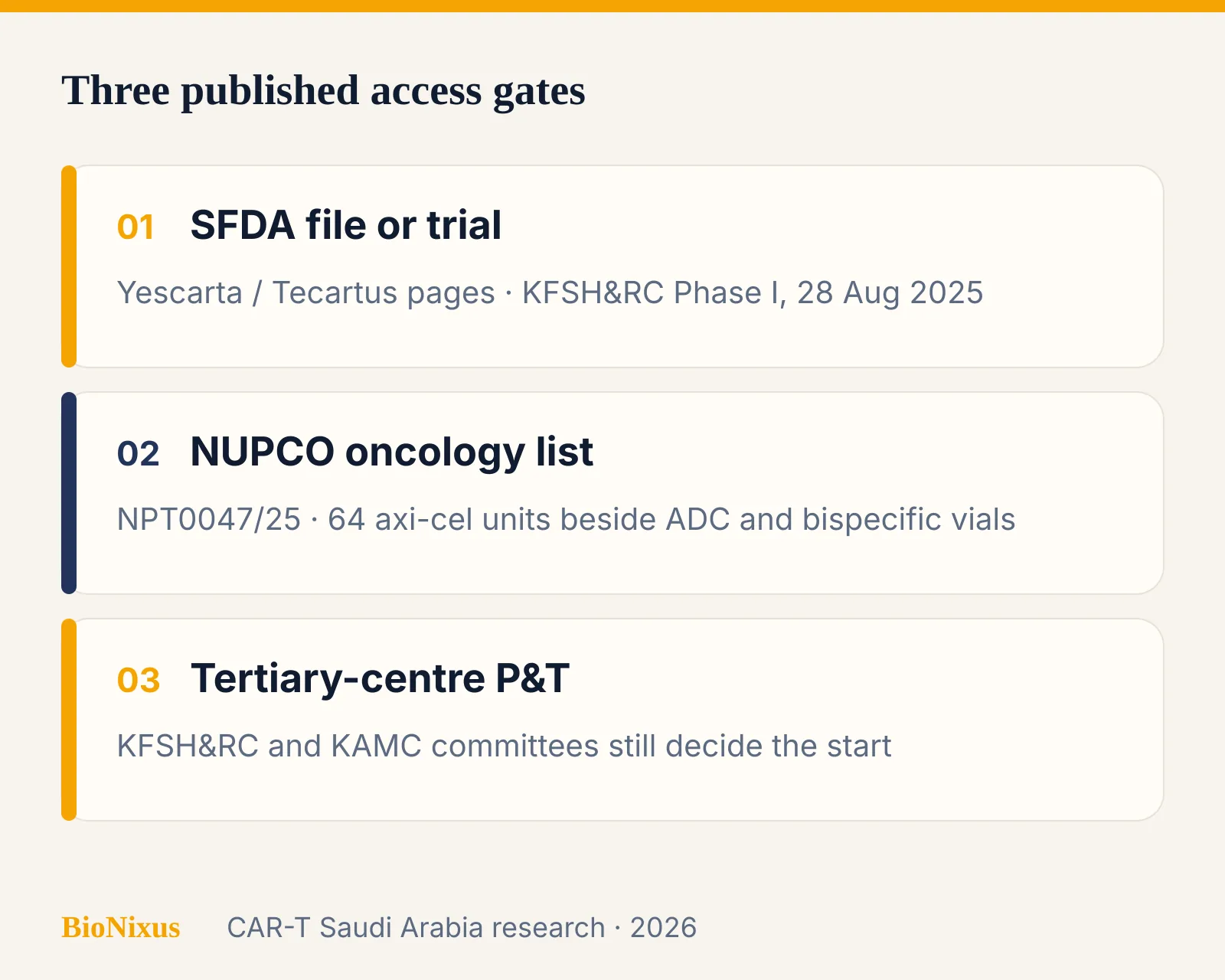
Start with the regulator, then the buyer, then the hospital committee. The Saudi Food and Drug Authority, or SFDA, decides whether a medicine can be sold or studied. Its Yescarta and Tecartus safety page prints an approval date of 18 October 2023 (SFDA Yescarta and Tecartus page). Yescarta and Tecartus are CAR-T products named on that page. A separate page covers Kymriah, also called tisagenlecleucel (SFDA Kymriah page). The new-drug list records Tecartus biological-drug registrations dated 1 May 2025 (SFDA approvals list). On 28 August 2025 the SFDA approved a Phase I trial of a closed-system CAR-T at King Faisal Specialist Hospital and Research Centre, for acute lymphoblastic leukaemia, a fast-moving blood cancer (SFDA, 28 August 2025).
The National Unified Procurement Company, NUPCO, buys medicines for government hospitals. Its open oncology framework is numbered NPT0047/25. The English page set the deadline at 4 February 2026 (NUPCO tender page). The item list dated 25 December 2025 includes 64 units of axicabtagene ciloleucel, the CAR-T also called axi-cel, 32,535 vials of trastuzumab deruxtecan, and 930 vials of teclistamab 90 mg/ml (NPT0047/25 list). A vial row is a planning quantity. It does not say a patient was treated.
A 2024 pricing note from the Pharmaceutical Pricing and Reimbursement Information network, PPRI, splits the path into layers. The SFDA cost-insurance-freight price is the ceiling for a tender. NUPCO runs group purchasing. Each hospital’s pharmacy and therapeutics committee still decides what that hospital will stock. Private insurance sits with the Council of Health Insurance, CHI (PPRI 2024).
Grand View Research, IMARC and Fortune Business Insights sell Saudi or Gulf oncology outlooks. Those pages describe a category. They do not name which chair will infuse the next patient. Use them as background. Take a centre study to the committee.
Hospital numbers that should stay apart
Three published counts use different clocks. Keep them in separate sentences.
- A 2024 survey of transplant and cell therapy reported CAR-T at three centres and 70 recipients (SSBMT survey, 2024). Table 1 of that paper is the CAR-T table for the Kingdom (Table 1). That survey is not a 2026 share of treated patients.
- An abstract at the 2024 American Society of Hematology meeting reported the first 50 axi-cel patients at King Faisal Specialist Hospital and Research Centre in Riyadh (Blood 2024 abstract). A companion abstract said 13 of those 50 received bridging radiotherapy, which is radiation given before the CAR-T infusion (Blood 2024 radiation abstract).
- A later paper in Cytotherapy extended the same Riyadh series to 77 patients, from February 2023 to November 2024. The overall response rate was 78 percent. The complete response rate was 49 percent (Cytotherapy series). Overall response means the cancer shrank or disappeared on the study’s measure. Complete response means no detectable cancer on that measure. Those rates belong to this series. They are not a national forecast.
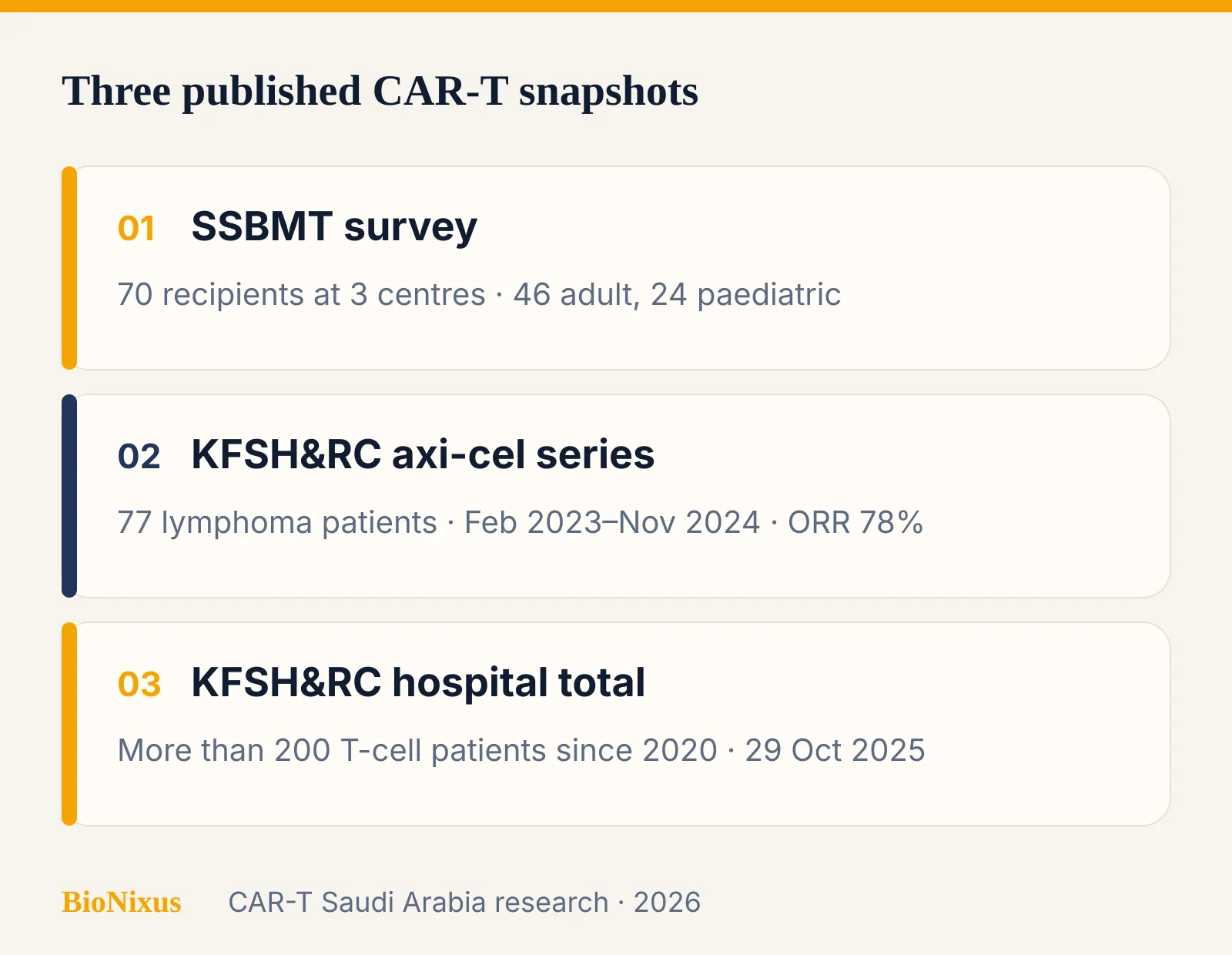
Hospital statements use yet another denominator. On 13 October 2025 the hospital said local T-cell production had moved the stated cost from 1.3 million Saudi riyals to about 250,000, and that it plans to scale to 100 treatments a year (King Faisal Specialist Hospital, 13 October 2025). A September 2025 note named the first locally made product as a Lentigen CD19 CAR-T in a Phase I trial for relapsed or refractory B-cell acute lymphoblastic leukaemia (King Faisal Specialist Hospital, September 2025). Relapsed or refractory means the cancer returned or did not respond to earlier treatment. On 29 October 2025 the hospital said it treats 200 patients with CAR-T and is launching local manufacturing (King Faisal Specialist Hospital, 29 October 2025).
Do not add 70, 50, 77 and 200 into one national total. They are different papers and different dates. The cost step and the 100-treatment plan are what the hospital said about local production. They are not a public list price for Yescarta. The Ministry of National Guard Health Affairs, in its 2024 annual report, lists advancing CAR-T and cellular treatment programmes. That report does not publish a treated-patient count (National Guard health affairs, 2024). A brief that quotes only the Riyadh hospital and skips the National Guard is a one-hospital study.
What the oncology tender list counts
Read NPT0047/25 once, as a planning list. A June 2026 copy of the item list was still posted (June 2026 copy). The terms allow updates every six months. An award stays valid for three years. The terms also apply SFDA rules and local-content rules (NPT0047/25 terms). Local content means a preference for work done in the Kingdom. The National Cancer Center’s goals include local content for cancer drugs and devices (National Cancer Center goals). Local manufacturing at one hospital is one project under that goal. It is not a curve for every hospital in the country.
On the December 2025 list, trastuzumab deruxtecan, teclistamab and axi-cel are different rows. Deruxtecan is an ADC used in some solid tumours. Teclistamab is a bispecific antibody. Axi-cel is a CAR-T. A slide that averages those rows hides the chair, the cold chain and the committee problem. Bid-window mechanics sit on the NUPCO tender market research briefing. This page keeps the list only as a signal of what was planned.
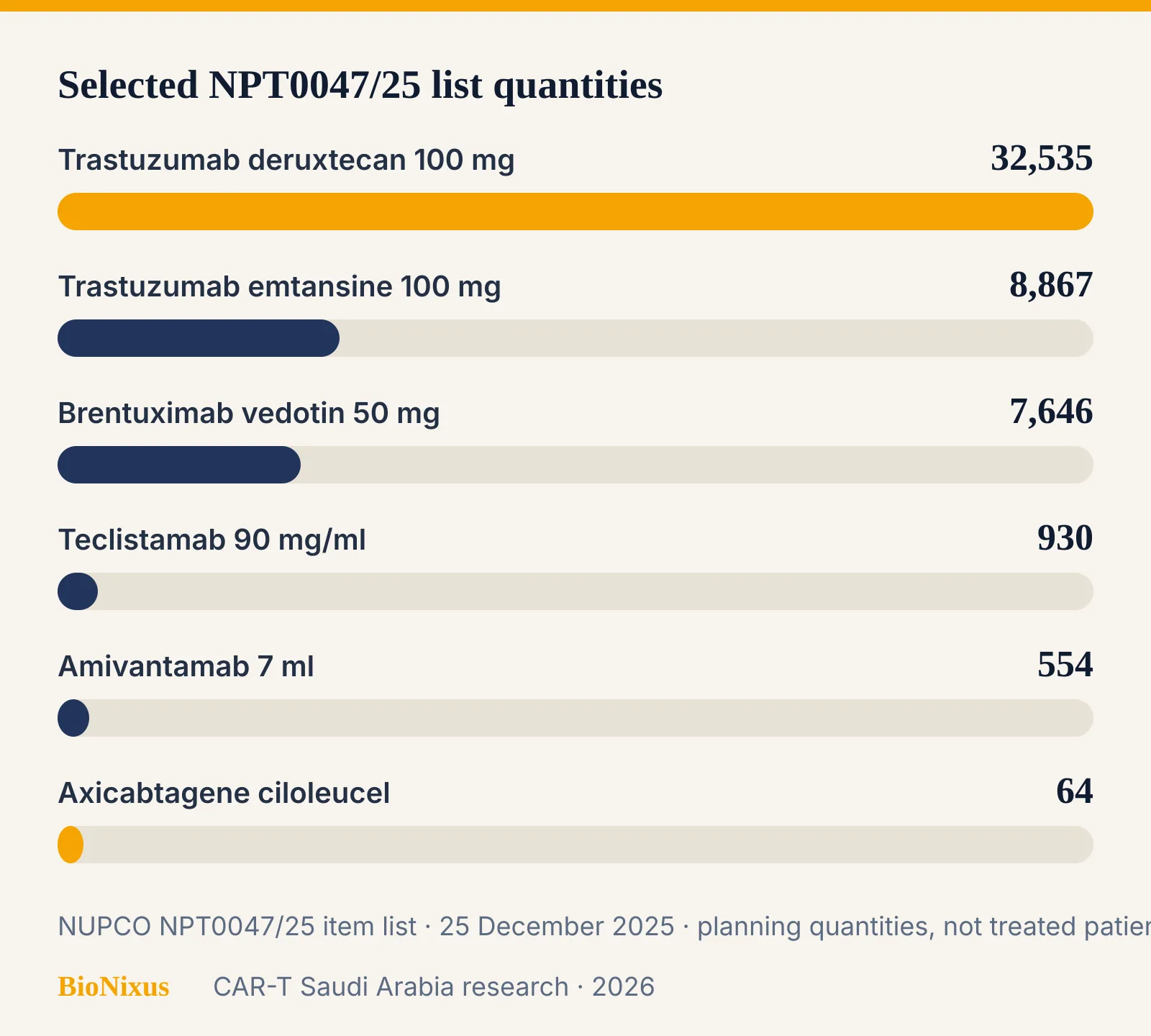
A listed axi-cel unit is not a statement that a hospital will stop using another CAR-T. An unlisted product is not proof that nobody uses it. The SFDA pages for Tecartus and Kymriah are a different file from the NUPCO extract. Interview the pharmacy lead. Do not infer the chair from the PDF.
Bispecific drugs already in the papers
A bispecific can be used before CAR-T, after it, or instead of it. The published glofitamab file already shows one of those paths. An abstract from a Saudi tertiary centre reported 30 patients, 23 of whom had already received CAR-T. The overall response rate was 56.6 percent (Blood 2024 glofitamab abstract). That is a centre series. It is not a national launch curve for every bispecific. A discussion guide that only asks “will you use a bispecific?” will come back thin.
Blinatumomab, another bispecific, already has a two-hospital paper. The abstract covers King Faisal Specialist Hospital and Research Centre and King Fahad Medical City, from 2018 to 2023, and looks at blinatumomab given with a tyrosine kinase inhibitor for Philadelphia-chromosome-positive B-cell acute lymphoblastic leukaemia (Blood 2023 abstract). A tyrosine kinase inhibitor is a targeted drug used when the leukaemia carries that chromosome change. The paper is a reminder that a bispecific can be in use at named hospitals on its own clock. Teclistamab’s 930 listed vials are a planning file. They are not this paper, and they are not a treated-patient count.
Who still has to say yes
A registration, a tender row and a hospital protocol are three yeses. PPRI’s 2024 note is the clean split: the SFDA ceiling comes first, NUPCO can buy for the group, and the hospital committee still decides what to stock. CHI is the private-insurance side. The CHI drug list, called Dhaman, is an open formulary of medicines the SFDA has registered (CHI formulary). On 27 October 2025, CHI said private insurance covered more than 14 million beneficiaries in the third quarter of 2025 (CHI, 27 October 2025). A start in a privately insured day unit is a different evidence pack from a protocol at King Faisal Specialist Hospital. Do not paste a government tender win into a private-claim forecast.
The Saudi Oncology Pharmacy Assembly published a 2024 paper on revitalizing access to cancer medicines (Saudi Oncology Pharmacy Assembly, 2024). Use it as the access paper it is. Ask the hospital who sits on the committee and how often the list is reviewed. Do not treat the paper as a headcount of every committee in the Kingdom.
King Faisal Specialist Hospital is publishing CAR-T results, running the SFDA-authorised Phase I, and stating a local-production plan. National Guard Health Affairs lists cellular-therapy programmes in the same 2024 report year and does not give a patient count. Those are two accounts. A protocol at one is not a protocol at the other.
Cancer counts are not chair time
The Saudi Cancer Registry was established in 1992 (Saudi Cancer Registry). The National Cancer Center publishes its annual reports (annual reports). In 2024 the registry recorded 27,771 new cancer cases, of which 22,728 were in Saudi nationals. Non-Hodgkin lymphoma accounted for 1,113 cases. Hodgkin lymphoma accounted for 684 (Saudi Cancer Registry, 2024).
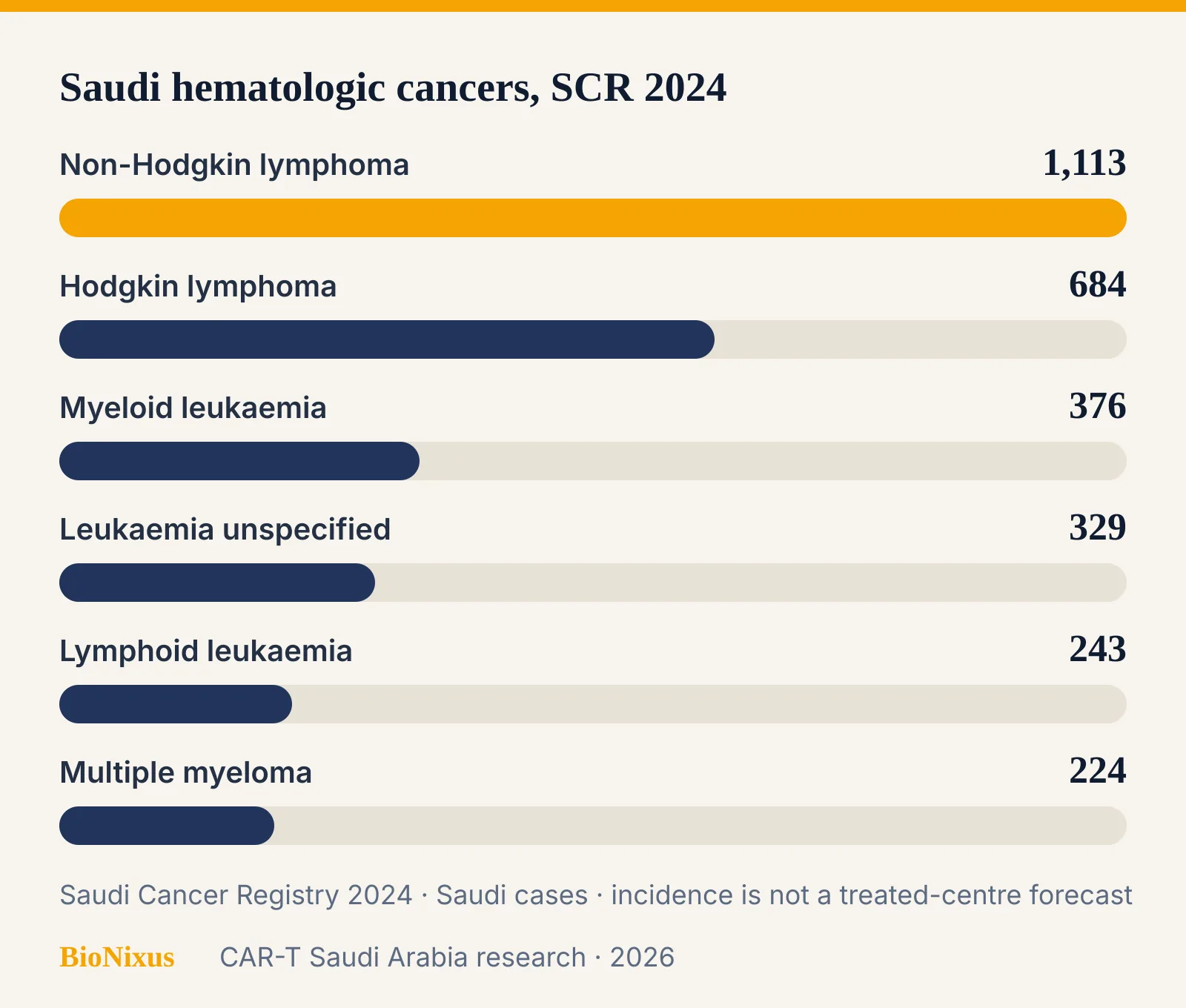
Those counts are new diagnoses. They do not say how many people will receive an ADC, a bispecific or a CAR-T, or in which city. Do not multiply registry cases by a relapse fraction from another country and call the result demand.
Hospital capacity is a third file. The General Authority for Statistics counted 516 hospitals in 2024, 115 of them in Riyadh Region and 99 in Makkah Region (GASTAT, 2024). Mid-2024 residents numbered 35.3 million (GASTAT population, 2024). Most of those hospitals do not run a cell-therapy chair. The survey’s three CAR-T centres are the tighter map. Saudi Vision 2030’s Health Sector Transformation Program includes the SEHA Virtual Hospital, which connects more than 150 hospitals (Vision 2030 health programme). That connection is not a list of hospitals that can manage CAR-T side effects. Category language for the wider market sits on the Saudi Arabia oncology market report. Use that page for the category. Use this page for the centre file.
Questions to put in the brief
Design the study backwards from one decision. That decision might be a hospital list, a framework offer, a local-manufacturing slot, or a CHI listing. A study that starts from a syndicated market-size slide will not answer it.
| Workstream | Decision it answers | What the published record already shows | What to commission |
|---|---|---|---|
| Authorised-centre capacity | Where the product can be given | A 2024 survey reported CAR-T at three centres (SSBMT 2024) | Interviews at the named hospitals on the brief |
| Construct mix | Which product reaches the chair | NPT0047/25 lists 64 axi-cel units (NPT0047/25 list) | Pharmacy interviews on the product in use |
| P&T gate | Who lists the product after SFDA | Hospital committees decide inclusion (PPRI 2024) | Committee interviews, not a national average |
| ADC chairs | Which day unit can prepare the drug | Trastuzumab deruxtecan is listed at 32,535 vials (NPT0047/25 list) | Pharmacy interviews on preparation time |
| Bispecific sequence | Before, after or instead of CAR-T | 30-patient glofitamab series: 23 with prior CAR-T (Blood 2024 abstract) | Anonymous PRFs that keep line of therapy and prior cell therapy in separate cells |
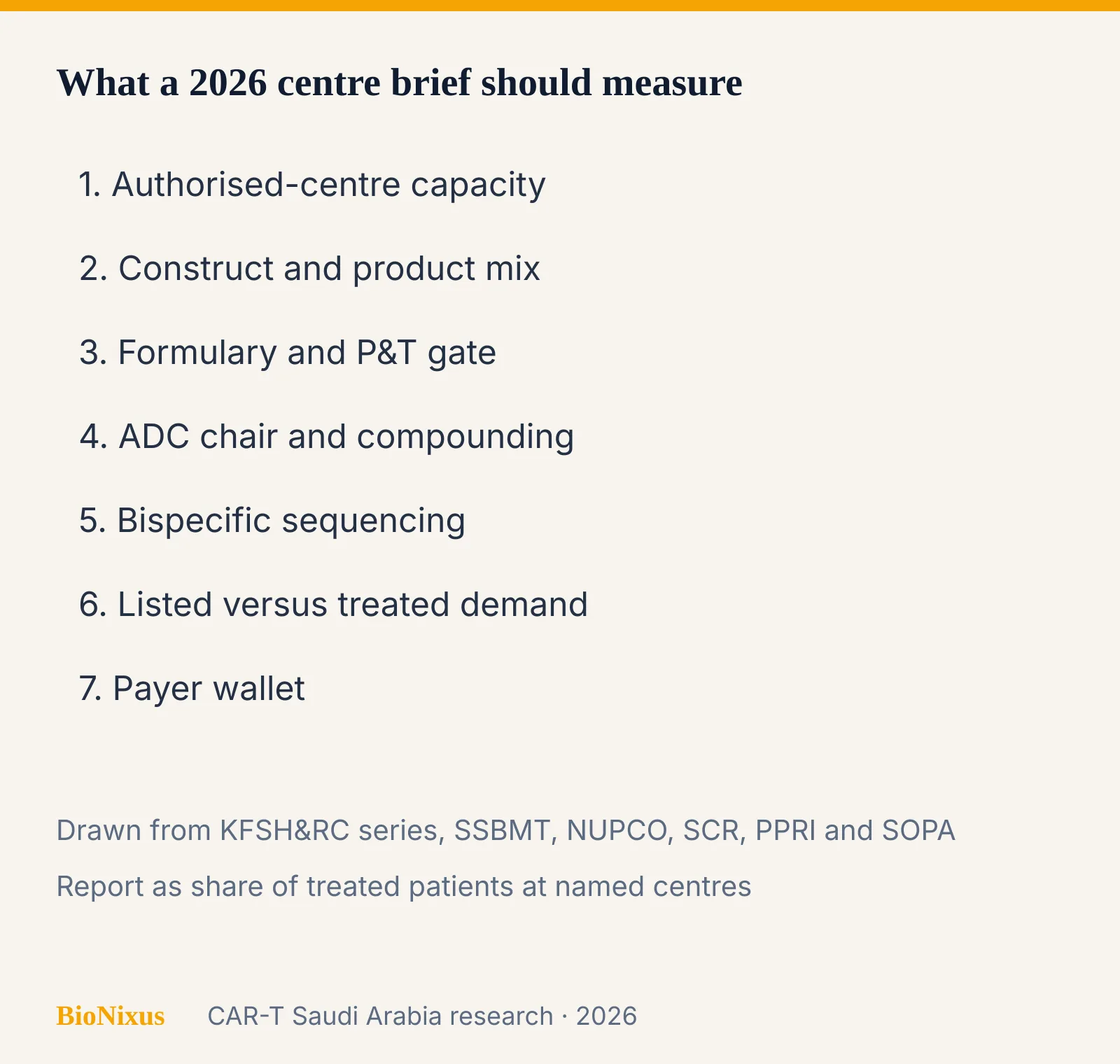
- Where it can be given. Name the hospital. The survey’s three centres and the 516-hospital count are different frames.
- Which product. Ask about axi-cel, the products on the SFDA pages, and the hospital’s in-house Lentigen study as separate items. The tender list’s 64 axi-cel units do not close the question.
- Who lists it. Interview the cancer committee, not a generic buyer. PPRI treats that committee as its own decision.
- What the list already shows. State the NUPCO code and the listed quantity, then measure what the pharmacy issues. Deruxtecan at 32,535 vials and axi-cel at 64 units cannot share one conversion factor.
- Where a bispecific sits. Keep prior CAR-T in its own column. The glofitamab series is the published template: 23 of 30 patients had already had CAR-T.
- Who pays. Keep King Faisal Specialist Hospital, National Guard hospitals, the NUPCO path and CHI in separate rows.
Report results as a share of patients treated at named centres. Do not report them as a share of listed vials. Ask for Arabic and English instruments. Ask which date sits on each official figure.
How to brief BioNixus
BioNixus is a primary market research firm for pharmaceutical, medical device and healthcare companies. It was founded in 2012. Custom studies are usually priced at $10k–$60k. The firm has 40 client reviews on its public profiles. The line “Guaranteed in writing” covers the agreed scope and timeline. It does not cover what the interviews will find.
Leadership offices are in Sheridan, Wyoming, London, and Sheikh Zayed, Giza. Field offices are in Dubai, Al Khobar, and Salmiya, Kuwait. São Paulo is a field office for LATAM.
To brief a centre study, use the contact form or email admin@bionixus.com. Say which hospital, which product and which decision the study has to answer.
References
- NUPCO. Open framework for oncology medicines, NPT0047/25. Deadline 4 February 2026. Source (accessed 17 October 2026).
- NUPCO. NPT0047/25 final item list (PDF), 25 December 2025. Axi-cel 64 units; trastuzumab deruxtecan 32,535 vials; teclistamab 90 mg/ml 930. Source (accessed 17 October 2026).
- NUPCO. NPT0047/25 item list, June 2026 copy (PDF). Source (accessed 17 October 2026).
- NUPCO. NPT0047/25 terms. Six-month updates; three-year validity; SFDA and local-content rules. Source (accessed 17 October 2026).
- Saudi Cancer Registry. Cancer Incidence Report 2024. 27,771 new cases; 22,728 Saudi. NHL 1,113; Hodgkin 684. Source (accessed 17 October 2026).
- Saudi Health Council, National Cancer Center. Annual reports page. Source (accessed 17 October 2026).
- Saudi Health Council, National Cancer Center. Saudi Cancer Registry page. Established 1992. Source (accessed 17 October 2026).
- KFSH&RC. Treats 200 patients with CAR-T therapy and launches local manufacturing. 29 October 2025. Source (accessed 17 October 2026).
- KFSH&RC. Local T-cell production; plans to scale to 100 treatments a year. 13 October 2025. Cost from SR 1.3 million to about SR 250,000. Source (accessed 17 October 2026).
- KFSH&RC. First locally manufactured Lentigen CD19 CAR-T in a Phase I R/R B-ALL trial. September 2025. Source (accessed 17 October 2026).
- SFDA. Approves first-of-its-kind gene-therapy trial for ALL. 28 August 2025. Phase I closed-system CAR-T at KFSH&RC. Source (accessed 17 October 2026).
- SFDA. Yescarta and Tecartus safety page. Approval date on page: 18 October 2023. Source (accessed 17 October 2026).
- SFDA. New drug approvals list. Tecartus biological-drug registrations dated 1 May 2025. Source (accessed 17 October 2026).
- SFDA. Kymriah (tisagenlecleucel) risk-minimisation page. Source (accessed 17 October 2026).
- Shaheen NA, et al. HCT and cell-therapy landscape survey in Saudi Arabia. Bone Marrow Transplant. 2024;59:867–873. CAR-T at three centres; 70 recipients. Source (accessed 17 October 2026).
- Shaheen NA, et al. Table 1. CAR T-cell therapy in KSA. Bone Marrow Transplant. 2024. Source (accessed 17 October 2026).
- KFSH&RC Riyadh. Real-world axi-cel outcomes in large B-cell lymphoma. Cytotherapy. 77 patients, February 2023–November 2024; ORR 78%; CR 49%. Source (accessed 17 October 2026).
- Non-Western real-world axi-cel experience from a Saudi tertiary centre. Blood. 2024;144(suppl 1):203769. First 50 KFSH&RC patients. Source (accessed 17 October 2026).
- Bridging radiation before anti-CD19 CAR-T in B-cell lymphoma, Saudi Arabia. Blood. 2024;144(suppl 1):202399. 13 of 50 received bridging XRT. Source (accessed 17 October 2026).
- Real-world glofitamab in relapsed/refractory large B-cell lymphoma at a Saudi tertiary centre. Blood. 2024;144(suppl 1):198772. 30 patients; 23 prior CAR-T; ORR 56.6%. Source (accessed 17 October 2026).
- Blinatumomab with TKI for Ph-positive B-ALL. Blood. 2023;142(suppl 1):180221. KFSH&RC and King Fahad Medical City, 2018–2023. Source (accessed 17 October 2026).
- Saudi Oncology Pharmacy Assembly. Revitalizing oncology medications access in Saudi Arabia. J Oncol Pharm Pract. 2024. Source (accessed 17 October 2026).
- PPRI. Pharmaceutical pricing in Saudi Arabia (2024). SFDA CIF ceiling; NUPCO; hospital P&T; CHI. Source (accessed 17 October 2026).
- Council of Health Insurance. CHI Drug Formulary (Dhaman). Open formulary of SFDA-registered medicines. Source (accessed 17 October 2026).
- Council of Health Insurance. More than 14 million private-insurance beneficiaries in Q3 2025. 27 October 2025. Source (accessed 17 October 2026).
- GASTAT. Healthcare Establishments and Workforce Statistics 2024. 516 hospitals; Riyadh 115; Makkah 99. Source (accessed 17 October 2026).
- GASTAT. Population Estimates Statistics 2024. Mid-2024 residents: 35.3 million. Source (accessed 17 October 2026).
- Ministry of National Guard Health Affairs. 2024 annual report lists advancing CAR-T and cellular treatment programs. Source (accessed 17 October 2026).
- Saudi Health Council, National Cancer Center. Strategic goals, including local content for cancer drugs. Source (accessed 17 October 2026).
- Saudi Vision 2030. Health Sector Transformation Program. SEHA Virtual Hospital connects more than 150 hospitals. Source (accessed 17 October 2026).
- Grand View Research. Saudi Arabia oncology / cancer market outlook pages. (accessed 17 October 2026).
- IMARC Group. Saudi Arabia cancer / oncology market report pages. (accessed 17 October 2026).
- Fortune Business Insights. Saudi Arabia / GCC oncology market report pages. (accessed 17 October 2026).